

Designing a normal PCB is one thing. Designing a board that hides components inside its layers is a very different challenge. The moment you place parts under the copper instead of on top of it, every choice you make becomes more critical. You gain smaller footprints, better signal behavior, and tighter thermal control. Still, you also take on new risks, especially when mistakes are sealed inside the laminate where you can’t touch them again.
If you ask any engineer who has done this before, they will tell you the same thing. Embedded components reward careful planning. They punish shortcuts. Blind Buried Circuits Inc as a reliable PCB assembly company works with teams that push stackups to their limits, so the lessons here come from real boards, real failures, and real fixes.
Think of this guide as a way to avoid the usual traps. It walks you through the decisions that matter most, from early part selection to final reliability checks, using clear explanations instead of buzzwords or sales talk.
Why Embedded Components Matter
The biggest reason engineers embed components is simple. You get more performance in less space. When the parts sit inside the board, you reduce height, shorten electrical paths, and steady the signals that would otherwise travel across longer, noisier routes.
1. The clear benefits
You’ll notice these improvements right away:
- Smaller layouts for wearables, medical tools, and compact modules
- Lower noise in high-speed, RF, and imaging circuits
- Better thermal spreading
- Fewer mechanical failures because the parts can’t vibrate loose
This is also why PCB design for imaging systems often relies on embedded passives. They help keep sensitive paths quiet.

2. When embedding doesn’t help
You don’t want to embed parts in every design. You should think twice if:
- You expect regular rework
- Your parts are thick or oddly shaped
- Your manufacturer can’t support the process
Your cost targets are extremely tight

3. Start with team alignment
Before drawing the first trace, talk to your PCB assembly company and your internal team. Everyone must agree on stackup limits, lamination steps, cost, and test plans. Embedded work leaves very little room for “we’ll fix it later.”
Choose Components Carefully
Once components go inside the board, removing them is almost impossible. That’s why selection is one of the most critical steps.
Passive vs active parts
Passives are usually the easiest. Embedded resistors, capacitors, and inductors behave predictably.
Active parts can also be embedded, but they demand tighter control over heat, alignment, and bonding.

Know the limits
Keep track of:
- Part thickness
- Maximum temperature ratings
- Material expansion (CTE)
- Power requirements
If a part expands differently from the surrounding laminate, your stackup can warp or crack during reflow or lamination.
Pick the right package.
Common embedded-ready styles include:
- Chip components
- Ultra-thin or thinned dies
- CSP
- Flip-chip
Each requires specific bonding, cavity depth, and routing access.
Check with your vendors.
Never assume a part is “embed-friendly.” Two similar components may behave very differently under lamination pressure. Always ask the vendor for confirmation.
Plan the Stackup Early
Your stackup isn’t just a list of layers. It decides how the embedded parts interact with everything around them.
Material choices
Choose cores and prepregs with the right:
- Resin content
- Thermal stability
- Thickness tolerance
They must match the internal component height, or the outer layers will warp.
Embedding methods
The common approaches are:
- Cavities cut in the core
- Build-up layers laminated over parts
- Coverlay pockets
- Microvia-connected sections
Each affects cost, yield, and process complexity.
Layer mapping matters
Assign signal, power, ground, and embedded parts carefully. Poor mapping creates crosstalk, slow edges, hot spots, and routing bottlenecks.
Dielectric decisions
Your dielectric affects permittivity. Higher permittivity slows signals. Lower permittivity improves high-speed paths but may increase cost.
Mechanical Rules You Must Follow
Here’s where many first-time designers stumble.
Cavity choices
You can use:
- Open cavities for easier placement
- Closed cavities for better protection
Closed cavities add steps during lamination, so your manufacturer must support them.
Clearance and support
Every embedded component needs:
- Side clearance
- Vertical standoff
- Mechanical support ribs or pads
Skipping these leads to cracked joints or crushed parts during lamination.
Orientation rules
Some dies require precise rotation for pad access and thermal spread. Plan the layout so assembly tools can reach bonding points.
Watch for warpage
Unbalanced stackups bend. Match materials across layers so the board stays flat through multiple heat cycles.
Manage Heat Properly
Embedded components trap heat inside the laminate. If you ignore this, you’ll shorten the board’s life.
Thermal paths
Use:
- Thermal vias
- Internal copper blocks
- Heavy copper where needed / copper coin technology (if needed)
Give heat a way out instead of letting it pool around one area.
Budget power correctly
List each part’s power use. Add margin. Hot spots inside the board are hard to detect and impossible to fix.
CTE mismatch
If a part expands faster than the surrounding resin, solder cracks form over time. This is a standard long-term failure mode.
Test under stress
Perform:
- Thermal cycling
- High-temperature operating tests
- Induced stress tests
These catch weak bonds before mass production.
Electrical Design and Signal Integrity
Embedding parts changes routing paths. Treat it as high-speed design even if your signals are slow.
Routing strategy
Use microvias, blind vias, and buried vias to reach embedded pads without long detours.
Impedance control
Embedded passives can clean up signal edges when placed correctly. Keep the trace width and spacing stable.
Power distribution
Embedded capacitors create a quiet local power network. They help reduce voltage dips during switching.
EMI control
Ground planes and shielding zones around noisy areas reduce radiation.
Via Strategy
Vias are your lifelines to the embedded parts.
Choose the right type.
Use:
- Microvias
- Blind vias
- Buried vias
They leave surface space free and keep the board compact.
Never drill through parts
This seems obvious, but it happens more often than you think. Always protect embedded zones in your via rules.
Reliability rules
Keep annular rings large enough and ensure plating thickness meets IPC standards.
Design for Manufacturability and Assembly
Your PCB assembly services team needs clean, consistent information.
Talk early
Share:
- DFM rules
- ODB++ files
- IPC stackup data
Process steps
A typical flow includes:
- Cavity milling
- Pick-and-place before lamination
- Several lamination cycles
- Electrical and structural test panels
Common failure modes
Watch for:
- Voids in cavities
- Lifted pads
- Incomplete resin flow
- Cracked parts from pressure
Testing and Inspection
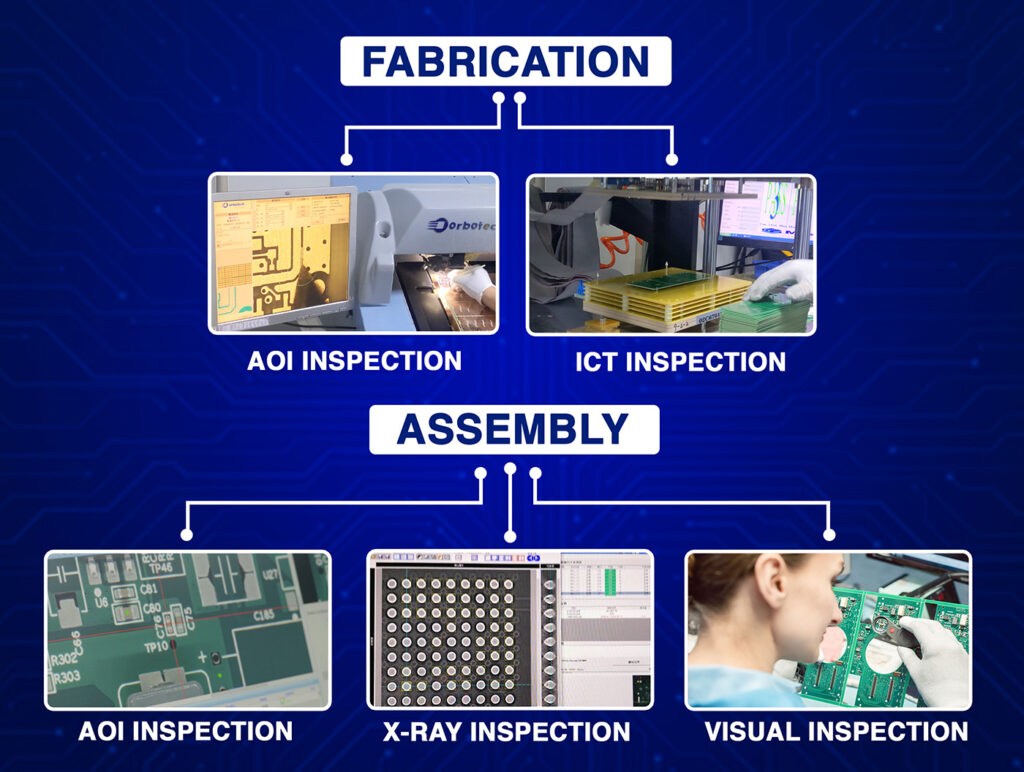
Since parts are hidden, you rely on advanced inspection.
Inspection methods
Most teams use:
- X-ray
- CT scanning
- Flying probe
- Boundary scan
Built-in test hooks
Add loops, pads, and test regions, so you have at least some access to buried circuits.
Repair is hard
Design expecting zero rework. Embedded parts rarely survive removal.
Materials and Surface Finishes
Your materials decide long-term stability.
Stack compatibility
Match resin content and cure cycles to prevent voids or delamination.
Surface finishes
ENIG, OSP, and immersion tin all behave differently during bonding. Choose based on your active/passive mix.
Adhesion
Surface prep before lamination improves strength.
Process Control and Vendor Management
Your build is only as good as your manufacturer’s discipline.
Monitor key parameters
Keep an eye on:
- Pressure
- Cure profiles
- Lamination temperature
Vendor audits
Check storage, humidity control, and material handling.
Traceability
Record every batch and process run. You’ll need it for failure analysis.
Reliability Engineering
Embedded boards must survive long-term stress.
Follow standards
Use relevant IPC, JEDEC, and IEC guidelines for electrical, thermal, and mechanical tests.
Accelerated tests
Life testing exposes weak joints and brittle regions.
Plan for years of use
Use conservative margins and stable materials.
Safety and Environmental Responsibility
Embedded parts change how the board behaves in end use.
Compliance
Verify RoHS and REACH for all materials.
High-voltage work
Keep spacing and insulation safe for medical or industrial products.
End-of-life planning
Some embedded designs complicate recycling. Plan accordingly.
Tools and Automation
Footprint creation
Build accurate embedded footprints, especially cavity dimensions.
Rule-based design
Use DRC and constraint systems that understand embedded components.
Stackup control
Lock layer counts, thickness, and materials early.
Cost and Schedule Planning
Embedding raises cost and increases turnaround time.
Expect:
- More lamination cycles
- Lower early yields
- Higher material costs
The process becomes cost-effective only at moderate or high volumes.
Practical Checklist
Before layout
- Confirm all embedded parts
- Freeze stackup and materials
- Align with your manufacturer
During layout
- Follow clearance and via rules
- Plan thermal paths
- Check impedance targets
Before production
- Approve test coupons
- Review FAI data
- Confirm lamination profiles
Conclusion
Designing PCBs with embedded components isn’t easy, but it becomes manageable when you follow a clear plan. You need patience, realistic expectations, and open communication with your PCB assembly company. Blind Buried Circuits sees these challenges in real projects every day, and the practices here reflect what actually works on the manufacturing floor. If you follow these guidelines, your design has a much better chance of moving from concept to working hardware without unpleasant surprises.
FAQs
1. What makes embedded-component PCB design different from standard PCB design?
Embedded components sit inside the board, so every stackup and thermal choice becomes more critical. Once sealed, you can’t rework them, so your PCB assembly company must support the full embedded process.
2. Which components are most suitable for embedding, and what limitations should I consider?
Thin passives and thinned dies work best because they tolerate lamination pressure. Always confirm with vendors and your pcb assembly services team since even similar parts can react differently inside the laminate.
3. Why is early stackup planning critical for PCB design with embedded components?
Stackup controls cavity depth, resin flow, impedance, and warpage—problems you can’t fix later. For high-speed or imaging systems, early alignment with your manufacturer prevents costly redesigns.
4. How do embedded components affect thermal and electrical performance?
They improve signal integrity by reducing noise and parasitics but trap heat inside the board. You must design clear thermal paths or risk long-term cracking and power instability.
5. How are embedded-component PCBs inspected or tested if the parts are buried inside the board?
X-ray, CT, and boundary-scan testing replace direct access since the parts can’t be reached. The goal is catching errors during fabrication because embedded boards are almost never repairable.