

Request our manufacturing capability
Capabilities
Rigid Flex PCB Manufacturer | Fabrication and Assembly Services
Precision Layouts. Proven Performance.
Our Capabilities
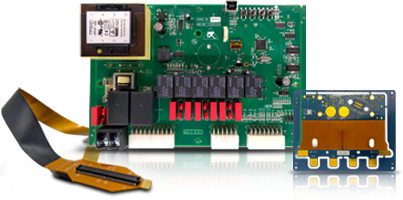
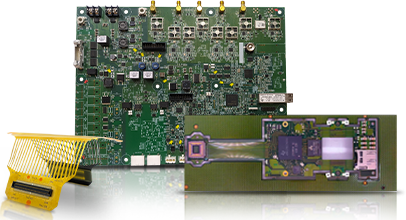
As a rigid flex PCB manufacturer, Blind Buried Circuits produces circuit boards that combine rigid board sections with flexible circuit layers in a single interconnected structure. This construction allows circuits to fold or bend within an assembly while maintaining electrical connections between sections.
For OEMs developing compact electronic products, rigid-flex circuit boards can help accommodate complex layouts, fit circuits into confined enclosures, and reduce reliance on separate cables and connectors. Blind Buried Circuits manufactures and assembles rigid-flex PCBs for OEMs seeking to integrate these benefits into their electronic products.
Types of Rigid Flex PCBs We Manufacture
Rigid-Flex PCB Fabrication Materials and Stack-Up Options
We support rigid-flex PCB construction with polyimide materials, copper layers, no-flow prepreg, shielding materials, and stiffeners. These options allow us to accommodate different rigid and flexible section configurations.
- Polyimide and Copper: We stock polyimide materials for flexible circuit construction and support copper thicknesses starting at ¼ oz. These materials form the dielectric and conductive layers of the flexible circuit sections.
- No-Flow Prepreg: We recommend no-flow prepreg for rigid-flex lamination. Its controlled resin flow helps prevent excess resin from entering designated flexible areas during bonding, preserving the intended construction.
- Shielding Materials: We support shielding options such as copper-based materials, conductive silver ink, carbon-based coatings, and Tatsuta EMI shielding films, depending on the electrical and mechanical requirements of the design.
- Stiffener Materials: We support polyimide (PI), FR-4, and metal stiffeners for localized reinforcement. We maintain 10 mil registration and 10% thickness tolerance for PI and FR-4 stiffeners.
- Coverlay and Stack-Up Construction: We use coverlay to protect flexible circuit areas. We support 5 mil coverlay registration and 4 mil PIC registration. For solder mask, we maintain 4 mil registration, 5 mil registration tolerance, and 3 mil bridging between dams.
Rigid and flexible layers are integrated through the lamination stack-up. We also support loose-leaf rigid-flex constructions with controlled air-gap tolerances and identify Eccobond as an option for strain relief, with a preferred minimum application space of 0.010 inch.
Rigid Flex PCB Assembly Services
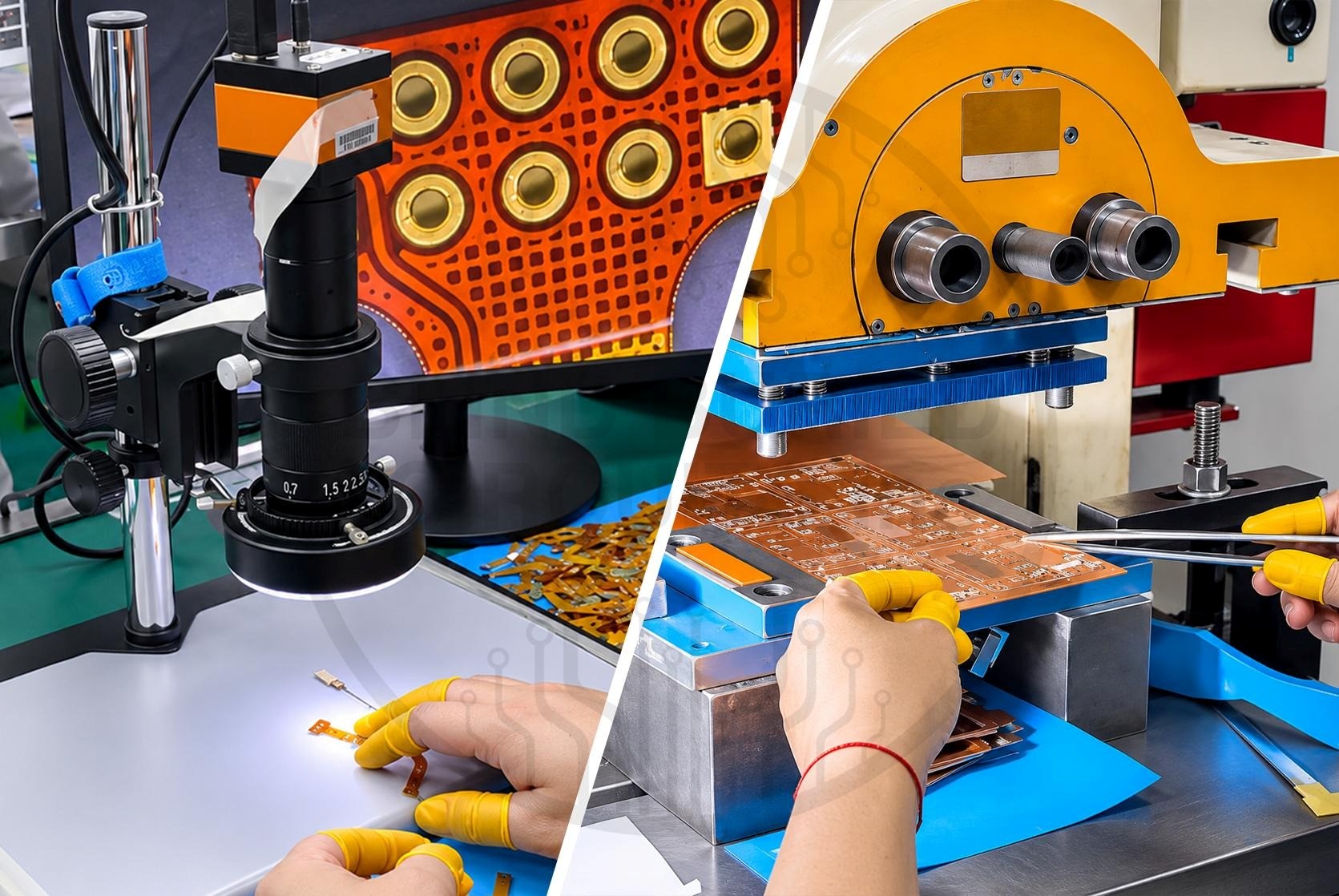
We provide rigid flex PCB assembly services cover component placement, soldering, and inspection, with the process selected according to the board construction and component requirements.
- SMT Assembly: Our SMT assembly process uses pick-and-place equipment to position surface-mount components on the board, followed by reflow soldering. We handle component packages ranging from small passive devices to fine-pitch components.
- Through-Hole Assembly: For through-hole components, we insert component leads into the designated plated holes and solder them to establish electrical and mechanical connections. We support wave soldering, selective soldering, and manual soldering, depending on the component layout and assembly requirements.
- Mixed-Technology Assembly: Some rigid-flex designs combine surface-mount and through-hole components. We support mixed-technology PCB assembly, bringing SMT placement and through-hole soldering processes together within the same build. The assembly sequence depends on component locations, soldering requirements, and board configuration.
- Assembly Inspection and Testing: We provide several inspection and testing options for assembled boards, depending on project requirements:
o Automated Optical Inspection (AOI): Checks component placement and visible solder-joint conditions.
o X-ray inspection: Supports inspection of hidden solder joints, including BGA connections.
o Visual inspection: Allows examination of component placement and soldering quality.
o In-Circuit Testing (ICT): Available for projects requiring electrical checks at the assembled-board level.
Rigid-Flex PCB Design Guidelines and Manufacturing Capabilities
Rigid-flex PCB fabrication requires careful consideration of layer construction, copper thickness, drilling requirements, shielding materials, and manufacturing tolerances. At Blind Buried Circuits, our engineering team reviews these specifications to evaluate manufacturing feasibility and support project-specific design requirements.
Panel and Layer Attributes
Attributes | Rigid-Flex PCB |
|---|---|
Maximum Layer Count | 4 |
Copper Thickness | ¼ oz to Hoz* |
Line Width and Spacing | 0.003″ |
Standard Panel Size | 3.94″ × 3.94″ |
Via and Drill Attributes
Attributes | Rigid-Flex PCB |
|---|---|
Minimum Microvia (Laser) Size | 1 mil |
Minimum Via (Laser) Size | 1 mil |
Minimum Mechanical Drill Diameter | 0.006″ |
ZIF Tolerance | 1 mil |
Tooling Tolerance | 1 mil |
Shielding and Stiffener Materials
Attributes | Rigid-Flex PCB |
|---|---|
Shielding Materials | Copper / Silver Ink / Tatsuta / Carbon |
Stiffener Materials | Polyimide / FR-4 / Metal |
PI Stiffener Registration | 10 mil |
PI Stiffener Thickness Tolerance | 10% |
FR-4 Stiffener Registration | 10 mil |
FR-4 Stiffener Thickness Tolerance | 10% |
Solder Mask and Coverlay Attributes
Attributes | Rigid-Flex PCB |
|---|---|
Solder Mask Registration | 4 mil |
Solder Mask Registration Tolerance | 5 mil |
Solder Mask Bridging Between Dams | 3 mil |
Coverlay Registration | 5 mil |
PIC Coverlay Registration | 4 mil |
Legend / Silkscreen Attributes
Attributes | Rigid-Flex PCB |
Registration | ±5 mil |
Minimum Space | 6 mil |
Minimum Width | 6 mil |
Minimum Height | 25 mil |
Benefits of Rigid Flex Circuit Boards
Rigid-flex circuit boards offers several practical advantages for electronic product design:
- Reduced Connector and Cable Requirements: Rigid-flex PCBs can replace separate cables, wire harnesses, and board-to-board connectors with integrated flexible circuit sections. This reduces the number of separate interconnection components needed between circuit areas.
- Compact Product Packaging: Flexible sections can fold around enclosure features and connect rigid board sections positioned at different angles or locations. This helps engineers use available internal space more efficiently, particularly in products with compact or irregular enclosures.
- Fewer Interconnection Points: By integrating circuit sections into one assembly, rigid-flex construction reduces the number of separate connector interfaces. Fewer connection points can reduce potential sources of contact failure associated with loose, damaged, or disconnected interfaces.
- Greater Product Layout Flexibility: Rigid-flex designs allow circuit sections to be arranged in three-dimensional configurations rather than being limited to flat board layouts. This gives product engineers more freedom to position components and route connections around mechanical constraints.
Rigid Flex PCB Applications by Industry
As a rigid flex PCB manufacturer, Blind Buried Circuits provides rigid-flex PCB fabrication for electronic applications requiring compact layouts, reliable interconnections, and flexible board configurations. Our rigid flex circuit boards support applications across various industries.
- Medical Devices: Rigid flex circuits are used in patient monitors, diagnostic equipment, hearing devices, and medical imaging systems where compact designs are important.
- Aerospace and Defense: Rigid flex PCBs support avionics, navigation equipment, communication systems, and electronic controls requiring compact interconnections.
- Automotive Electronics: Rigid flex circuit boards are used in instrument clusters, vehicle displays, sensor modules, and electronic control units.
- Telecommunications: Rigid-flex PCBs support communication modules, network equipment, and signal-processing systems where space-efficient circuit layouts are needed.
- Industrial Equipment: Rigid flex circuits are used in industrial controllers, monitoring systems, sensors, and test equipment.
- Compact Electronic Devices: Rigid-flex PCBs support smartphones, wearable devices, and portable electronics by reducing the need for separate cables and connectors.
Our capabilities include rigid-flex PCB fabrication and rigid flex PCB assembly, with rigid PCB assembly services available for applicable electronic manufacturing requirements.
Why Choose Blind Buried Circuits Inc. for Rigid Flex PCB Manufacturing?
At Blind Buried Circuits, we combine engineering support, quality management, and coordinated manufacturing services to support customer requirements for rigid flex PCB manufacturing.
- Engineering Collaboration: Our engineering team provides DFM and DFA reviews to assess design files, stack-up requirements, and potential fabrication or assembly concerns before production.
- Quality Management: BBC Inc maintains quality management systems certified to ISO 9001, ISO 13485, and ISO 14001, subject to current certificate scope and validity. Rigid-flex fabrication and assembly are evaluated against applicable IPC requirements and the acceptance class specified for each order.
- Production Flexibility: We support prototype builds and production orders, helping customers progress from initial design evaluation to manufacturing.
- Coordinated Manufacturing Services: Our services include PCB fabrication, component procurement, and rigid flex PCB assembly, providing a coordinated approach to manufacturing.
- Project and Customer Support: Our engineering, project management, and customer service teams assist with technical documentation, quotations, design reviews, and production coordination throughout the order process.
Frequently asked questions
Rigid-flex PCBs use polyimide for flexible sections, rigid laminates for board areas, and copper for conductive layers. No-flow prepreg, coverlay, and stiffeners support bonding and protection.
A rigid-flex PCB stack-up defines the arrangement of copper layers, dielectric materials, and bonding materials across rigid and flexible sections. It determines board thickness, electrical connections, and flexibility.
The bend radius depends on flex thickness, layer count, copper construction, and bending cycles. Static and dynamic flex designs require different considerations when establishing the minimum radius.
Yes. Components are generally mounted on rigid sections for mechanical support. Flexible sections connect these areas, while stiffeners can provide additional support around connectors and component mounting locations.
Rigid-flex PCB assembly can involve SMT, through-hole, and mixed-technology processes. Component placement, soldering methods, and board support depend on component packages and the circuit construction.
Typical rigid-flex PCB fabrication documents include Gerber or ODB++ files, drill files, stack-up drawings, and fabrication notes. Assembly orders may also require a BOM and component placement files.







Ready To Get Started?
Please call or email our engineering team at engineering@blindburiedcircuits.com for further assistance.