

Request our manufacturing capability
Capabilities
PCB Electrical Testing Services
Our Capabilities
Printed circuit board (PCB) testing is a critical quality assurance process used to verify the electrical integrity and functionality of a manufactured PCB at different stages of production and assembly. Electrical testing helps identify defects such as open circuits, short circuits, incorrect net connections, and other manufacturing-related issues that may affect product performance and reliability. It is commonly performed on prototype, low-volume, and production circuit boards across industries including telecommunications, aerospace, medical devices, industrial electronics, and automotive systems.
At Blind Buried Circuits, we provide PCB testing services for a wide range of board technologies, helping customers validate circuit connectivity, improve product quality, and reduce the risk of failures in the field.
What is PCB Electrical Testing
PCB electrical testing is the process of verifying that a manufactured circuit board matches its intended electrical design. During testing, the board is evaluated for continuity, isolation, and connectivity to ensure that all electrical networks perform as specified.
An electrical test PCB procedure can detect manufacturing defects that may not be visible during visual inspection. By comparing the physical board against design data such as netlists and fabrication files, testing helps confirm that the PCB meets required electrical specifications before PCB assembly or deployment.
Common defects identified during testing include:
- Open circuits
- Short circuits
- Incorrect net connections
- Missing connections
- Conductivity-related manufacturing defects
Types of PCB Electrical Testing We Perform
Blind Buried Circuits provides PCB testing services that support a wide range of board technologies, manufacturing requirements, and production volumes. Our testing capabilities help verify electrical integrity, identify manufacturing defects, and support consistent product quality.
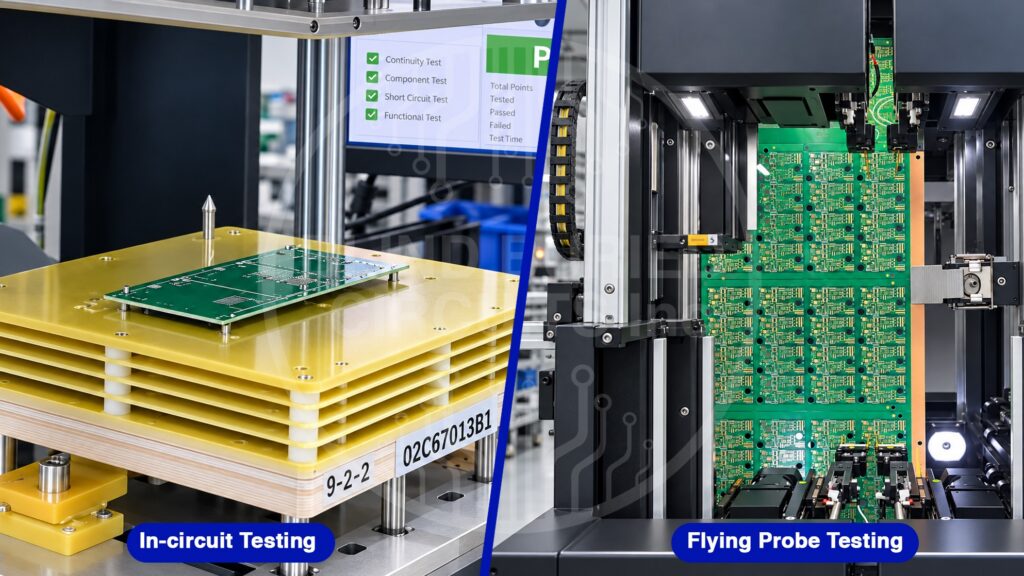
- Flying Probe Testing: This testing uses movable probes to verify electrical connections without dedicated fixtures. This method is commonly used for prototypes, engineering samples, and low-volume production because it offers flexibility, quick setup, and cost-effective electrical verification.
- In-circuit Testing (ICT): In-circuit testing uses a bed-of-nails fixture to verify circuit continuity, detect shorts and opens, and evaluate component-level electrical performance. This approach is commonly used for medium- and high-volume manufacturing where testing speed and repeatability are important.
- Boundary Scan Testing: This testing uses JTAG-based infrastructure integrated within compatible devices to verify electrical connections and support testing of complex digital circuits. This method can be particularly useful when physical test access is limited.
- Functional Testing: The functional testing evaluates whether a completed board performs according to its intended operating requirements. This verification method helps confirm overall circuit functionality before final deployment.
Why is Electrical Printed Circuit Board Testing Important
Printed circuit board testing helps verify electrical integrity, identify manufacturing defects, and support consistent product quality. The following are some key benefits of printed circuit board testing:
- Early Defect Detection: Electrical testing helps identify open circuits, short circuits, incorrect net connections, and other manufacturing-related defects before boards proceed to assembly. Detecting issues early reduces the risk of defective products moving further through the manufacturing process and minimizes potential production disruptions.
- Improved Product Quality: Verifying electrical connectivity helps ensure that manufactured boards meet intended design requirements. Consistent testing supports higher production yields and helps maintain quality standards across prototype and production quantities.
- Reliable Performance: Testing confirms that critical circuit networks function as designed and that all required connections are present. This verification helps reduce the likelihood of electrical failures during assembly, functional testing, or field operation.
- Lower Manufacturing Costs: Identifying defects before component installation helps reduce rework, troubleshooting, and repair efforts. Early verification can also help prevent unnecessary material consumption and delays later in the production cycle.
- Verification of Complex Designs: Multilayer PCB, HDI, blind via, and buried via PCBs often contain intricate internal structures that cannot be visually inspected. Electrical testing helps confirm reliable connectivity throughout the board and supports the performance requirements of advanced electronic applications.
- Quality Control and Traceability: Documented testing results provide verification that boards have been evaluated against specified electrical requirements. These records support traceability initiatives, quality management processes, and long-term reliability programs.
Benefits of Printed Circuit Board Electrical Testing
Electrical testing provides significant advantages throughout the PCB manufacturing process. The following are some key benefits:
- Early Defect Detection: Identifying electrical faults before component assembly helps prevent defective boards from progressing through the manufacturing process. Early detection of issues such as open circuits, short circuits, and incorrect connections can reduce rework requirements and minimize production delays.
- Improved Product Reliability: Electrical verification helps confirm that manufactured boards perform according to design specifications. This reduces the likelihood of failures during assembly, functional testing, or field operation, supporting long-term product reliability.
- Support for Advanced PCB Technologies: Testing solutions are available for multilayer, HDI, blind via, buried via, and other complex PCB structures. Additional electrical verification helps confirm reliable connectivity within intricate board designs used in high-performance electronic applications.
- Flexible Testing Solutions: Testing capabilities support prototype quantities, low-volume production, and larger manufacturing programs. This flexibility allows manufacturers to apply testing methods that align with project requirements and production volumes.
- Consistent Quality Verification: Standardized testing procedures help maintain product consistency and provide confidence that each board meets specified electrical requirements. Documented testing processes also support quality control initiatives and manufacturing traceability.
- Faster Manufacturing Turnaround: Integrating testing activities within the manufacturing workflow helps streamline production and identify issues earlier. This supports more efficient manufacturing operations and contributes to reliable delivery schedules.
Guidelines for Printed Circuit Board Testing
Effective printed circuit board testing begins with proper planning and accurate design data. Following established testing practices can improve defect detection and support consistent manufacturing quality.
- Define Testing Requirements Early: Testing objectives should be established during the design stage to ensure appropriate verification methods are selected for the application and production volume.
- Provide Complete Design Documentation: Accurate netlists, Gerber files, fabrication drawings, and engineering documentation help ensure reliable electrical verification and reduce testing discrepancies.
- Include Accessible Test Points: Well-designed test access points improve testing efficiency and allow more comprehensive electrical verification of critical circuit networks.
- Match the Test Method to Production Volume: Flying probe testing is often suitable for prototypes and small batches, while fixture-based testing may provide greater efficiency for larger production runs.
- Verify Complex PCB Structures: Multilayer boards, HDI PCB designs, and PCBs containing blind or buried vias may require additional verification to confirm reliable internal layer connectivity.
- Test Before Assembly: Performing an electrical test PCB verification before component assembly helps identify manufacturing defects early and reduces downstream troubleshooting costs.
- Maintain Testing Records: Documented test results and manufacturing records support traceability, quality control initiatives, and long-term product reliability programs.
Why Choose Blind Buried Circuits for PCB Electrical Testing?
At Blind Buried Circuits, we combine years of PCB manufacturing experience with advanced electrical testing capabilities to help customers verify board quality before assembly and deployment. All testing is performed in the USA using modern Flying Probe, In-Circuit (ICT), and fixture-based testing systems. We support automotive, aerospace, medical, semiconductor, industrial, telecommunications, and defense applications, with every PCB thoroughly tested to verify electrical connectivity and identify manufacturing defects.
Frequently Asked Questions
Yes. Modern testing methods accommodate boards with multiple layers, intricate and dense traces, as well as advanced features like blind and buried vias.
Yes. Testing early allows you to resolve issues before mass production, which helps optimize time and costs during later stages.
Tests can be completed within seconds once the software is set up or a fixture is prepared. For samples, flying probe testing is quick, while a bed-of-nails fixture provides extremely fast testing for larger batches.
You receive a comprehensive report detailing all items checked, pass/fail criteria, and test results, along with documentation for audits, allowing you to improve future designs.
Yes. Different configurations, including flex, rigid, and rigid-flex PCBs, can be tested using modern testing methods to provide accurate results regardless of the design.







Ready To Get Started?
To learn more about our PCB Design Guidelines, don’t hesitate to contact our sales team at sales@blindburiedcircuits.com.