

Request our manufacturing capability
Capabilities
Rogers Printed Circuit Board
Our Capabilities
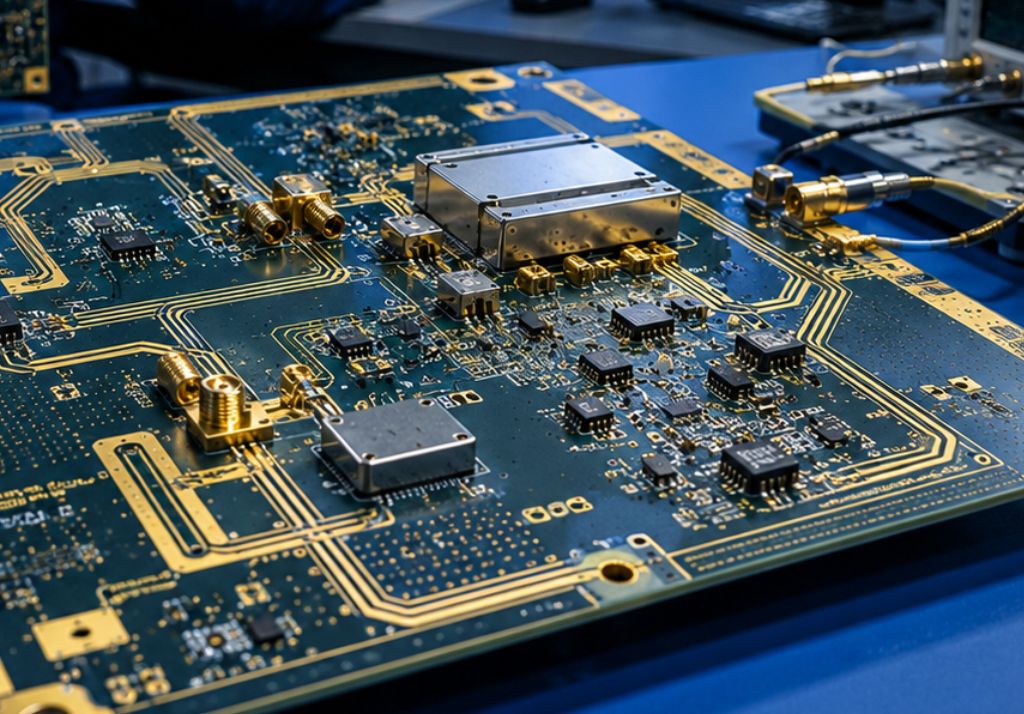
Rogers printed circuit boards are engineered using high-frequency laminates and advanced materials designed to deliver exceptional electrical performance in demanding applications. These PCBs are widely used in high-speed electronic systems where signal integrity, thermal stability, and low dielectric loss are essential. At Blind Buried Circuits, we specialize in Rogers PCB manufacturing for prototypes, low-volume builds, and production requirements. As an experienced Rogers PCB manufacturer, we work with a range of Rogers circuit board material options to meet specific electrical and mechanical performance requirements.
Rogers PCB Manufacturing Services Offered by Blind Buried Circuits
Blind Buried Circuits provides specialized Rogers PCB fabrication services for applications that require superior high-frequency performance, stable electrical characteristics, and reliable operation in demanding environments.
- Rogers PCB Fabrication: We manufacture circuit boards using a variety of Rogers circuit board materials, including laminates designed for RF and microwave applications. These materials offer lower dielectric loss and more stable electrical performance than conventional FR-4, making them suitable for designs operating at high frequencies.
- Multilayer Rogers PCBs: Many advanced electronic systems require multilayer constructions to support complex routing, controlled impedance requirements, and compact form factors. We manufacture multilayer Rogers circuit boards with carefully engineered stackups to help maintain signal integrity across high-frequency designs.
- RF and Microwave Circuit Boards: Rogers materials are widely used in RF and microwave applications because of their low loss characteristics and consistent dielectric properties. Our manufacturing processes are designed to support applications such as antennas, power amplifiers, filters, radar systems, and wireless communication equipment.
- Hybrid Rogers and FR-4 Constructions: In some designs, Rogers materials are used only in critical RF sections while FR-4 is used in other areas to reduce overall cost. We support hybrid constructions that combine Rogers laminates and FR-4 within a single PCB stackup while addressing the manufacturing considerations associated with mixed-material designs.
- Controlled Impedance Manufacturing: Signal integrity is critical in high-frequency and high-speed electronic products. We work closely with customers to develop stackups and fabrication processes that support controlled impedance requirements for transmission lines, RF circuits, and high-speed digital interfaces.
- Design Review and Manufacturability Support: Before production begins, our engineering team reviews design files, stackups, material selections, and fabrication requirements. This process helps identify potential manufacturing challenges early and supports a smoother transition from design to production.
- Inspection and Quality Verification: Rogers PCBs often serve performance-critical applications where reliability is essential. Our quality control procedures include dimensional inspection, electrical testing, and process verification to help ensure that manufactured boards meet customer specifications.
- Prototype and Production Manufacturing: Whether customers require prototype quantities for design validation or ongoing production volumes, we provide scalable Rogers PCB manufacturing services with a focus on consistency, traceability, and product quality throughout the manufacturing cycle.
Benefits of Choosing Our Rogers PCB Manufacturing Services
Selecting the right Rogers PCB manufacturer is essential for achieving reliable performance in high-frequency and mission-critical applications. The following are some key benefits of our Rogers PCB manufacturing services:
- Optimized Performance for High-Frequency Applications: Rogers circuit board materials offer low dielectric loss and stable electrical properties, helping maintain signal integrity in RF, microwave, and high-speed designs.
- Material Selection Based on Application Requirements: Different Rogers materials are designed for different performance needs. We help customers choose suitable material options based on frequency, thermal, and environmental requirements.
- Reduced Signal Loss and Improved Reliability: Precise fabrication processes and controlled impedance manufacturing help minimize signal degradation and support consistent performance throughout the product lifecycle.
- Flexible Prototype and Production Quantities: Whether developing a new product or scaling an existing design, our manufacturing capabilities support both prototype builds and ongoing production requirements.
- Faster Transition from Design to Manufacturing: Early manufacturability reviews and project planning help identify potential issues before fabrication, reducing delays and supporting a smoother production process.
- Single Source Manufacturing Partner: As a Rogers PCB supplier, we provide fabrication support for a wide range of applications, simplifying project coordination and helping customers manage procurement more efficiently.
Rogers PCB Materials We Work With
As an experienced Rogers PCB manufacturer, we support a wide range of Rogers circuit board materials. Our team can assist with material selection based on frequency requirements, dielectric properties, thermal performance, and fabrication considerations.
- RO4350B: One of the most widely used Rogers laminates, RO4350B offers a balance of low dielectric loss, thermal stability, and manufacturability. It is commonly used in RF amplifiers, antennas, wireless infrastructure, and automotive radar applications.
- RO4003C: RO4003C is a hydrocarbon ceramic laminate designed for high-frequency circuits requiring low loss and consistent electrical performance. It is frequently specified for microwave systems, satellite communications, filters, and high-speed digital designs.
- RO3003: RO3003 provides a stable dielectric constant and low loss characteristics across a wide frequency range. It is commonly used in automotive radar, satellite communication systems, and millimeter-wave applications.
- RO3006 and RO3010: These high dielectric constant materials enable circuit miniaturization while maintaining reliable RF performance. They are often selected for filters, couplers, power amplifiers, and space-constrained microwave designs.
- RT/duroid® 5880: RT/duroid 5880 is an ultra-low-loss PTFE-based laminate widely used in aerospace, defense, radar, and satellite communication systems where signal loss must be minimized at higher frequencies.
- RT/duroid® 6002: This material combines low loss performance with excellent dimensional stability, making it suitable for high-reliability RF and microwave applications that require precise electrical characteristics.
- TMM® Series Materials: TMM laminates provide a combination of controlled dielectric properties, mechanical stability, and ease of processing. They are commonly used in antennas, RF components, and high-frequency multilayer circuit boards.
- Rogers and FR-4 Hybrid Stackups: For applications requiring RF performance in specific sections of the design, we support hybrid constructions that combine Rogers materials with FR-4 substrates to optimize both performance and overall manufacturing cost.
Tips for Choosing the Right Rogers Printed Circuit Board
Selecting the right Rogers circuit board material depends on your application’s electrical, thermal, mechanical, and cost requirements. Consider the following factors when evaluating material options:
- Operating Frequency: Higher-frequency applications often require low-loss materials that help maintain signal integrity and minimize transmission losses across RF and microwave circuits.
- Dielectric Constant Requirements: The dielectric constant (Dk) influences signal propagation and circuit size. Selecting the appropriate Dk value helps achieve the desired electrical performance and impedance targets.
- Thermal Performance: Applications exposed to elevated temperatures or significant thermal cycling may require materials with enhanced thermal stability and reliable performance under demanding operating conditions.
- Controlled Impedance Needs: For RF, microwave, and high-speed digital designs, the material should support accurate impedance control to ensure consistent signal transmission and reduced reflections.
- Mechanical and Environmental Requirements: Factors such as moisture resistance, dimensional stability, and operating environment should be considered when selecting a Rogers PCB material for long-term reliability.
- Cost and Design Complexity: In some applications, a hybrid stackup combining Rogers materials and FR-4 can provide the required electrical performance while helping optimize overall manufacturing costs.
Frequently Asked Questions
It is a printed circuit board made with special, high-frequency materials from Rogers Corporation. It is better than standard boards for high-speed, high-frequency signals.
Industries like aerospace, telecom, and medical devices need fast and reliable signals. Rogers material reduces signal loss and withstands tough conditions.
Assembling Rogers PCBs requires precision and care because the materials handle heat and pressure differently than standard boards.
Yes, you can combine layers of Rogers material with regular FR4 to get a good balance of cost and performance.
They allow more routing space inside the board without bigger size, making devices smaller and faster.
It can be costlier than standard board materials, but the benefits often outweigh the costs in high-performance applications.
At Blind Buried Circuit, we help you choose the right materials and stack-ups.
Yes, especially where small size and fast signals matter for products like phones and wearables.







Ready To Get Started?
To learn more about our PCB Design Guidelines, don’t hesitate to contact our sales team at sales@blindburiedcircuits.com.