

Request our manufacturing capability
Capabilities
Quick Turn Rigid Flex PCB Manufacturer
Our Capabilities
Quick-turn rigid-flex manufacturing requires more than simply shortening fabrication lead time. Stackup construction, bend regions, rigid-to-flex transitions, material selection, and via placement must be reviewed early to avoid manufacturability or reliability problems during an accelerated build.
Blind Buried Circuits provides quick turn rigid-flex PCB manufacturing for prototypes, engineering builds, pilot runs, and production requirements. Our team supports custom rigid-flex constructions with engineering review focused on both fabrication requirements and the electrical and mechanical demands of the finished board.
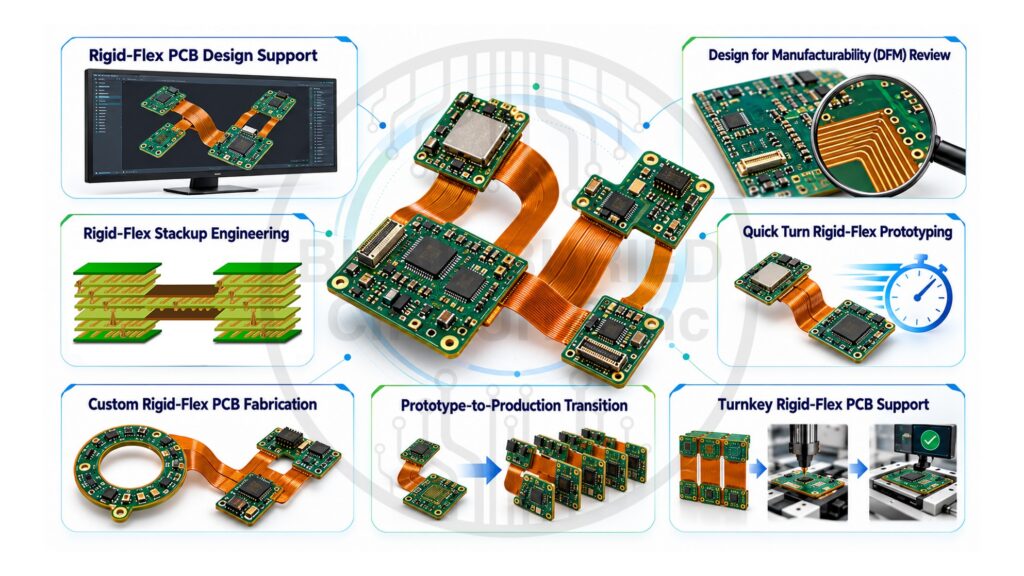
Quick Turn Rigid-Flex PCB Manufacturer Services Offered by Blind Buried Circuits
BBC supports time-sensitive rigid-flex PCB programs with services covering the critical stages required to move a design into fabrication. Here are the key services we offer for Fast turn rigid-flex PCB projects.
- Rigid-Flex PCB Design Support: We assist with rigid-flex design considerations such as rigid-to-flex transitions, bend regions, conductor routing, stiffener placement, coverlay requirements, and overall board configuration to support manufacturability.
- Design for Manufacturability (DFM) Review: Our team reviews submitted designs for stackup construction, flex-layer requirements, bend geometry, annular rings, clearances, via placement, and other fabrication considerations before manufacturing begins.
- Rigid-Flex Stackup Engineering: We help establish appropriate rigid and flexible layer arrangements, dielectric thicknesses, copper weights, bonding materials, and overall construction based on the electrical and mechanical requirements of the design.
- Quick Turn Rigid-Flex Prototyping: We produce small-volume quick turn custom rigid-flex PCBs for early design evaluation, helping customers verify board geometry, rigid-to-flex transitions, bend areas, component placement, and overall fit before proceeding to production.
- Custom Rigid-Flex PCB Fabrication: We manufacture application-specific rigid-flex boards with custom outlines, flex sections, layer structures, bend configurations, stiffeners, and other design-specific requirements.
- Prototype-to-Production Transition: We support the transition of approved rigid-flex designs from initial builds into repeat production while maintaining the established fabrication requirements and board configuration.
- Turnkey Rigid-Flex PCB Support: Being a prominent Quick Turn Rigid Flex PCB Manufacturer, we provide integrated rigid-flex PCB fabrication, component sourcing, assembly, and testing through a single manufacturing partner, simplifying project coordination from board production through final PCB assembly.
Rigid-Flex PCB Materials We Work With
Material selection for rigid-flex PCBs depends on electrical performance, flexibility, thermal conditions, and overall board construction. BBC works with a range of materials to support different rigid-flex PCB design and manufacturing requirements.
Material | How We Use It in Rigid-Flex PCBs |
FR-4 Laminates | Used in rigid sections where mechanical stability, electrical insulation, and structural support for components and circuitry are required. |
Polyimide Flex Materials | Used in flexible sections to provide flexibility, thermal stability, and electrical insulation for bending applications. |
Copper Foils | Rolled-annealed (RA) and electrodeposited (ED) copper options can be selected based on flex requirements, circuit construction, and the intended application. |
Polyimide Coverlay | Used to protect flexible circuit areas, insulate copper traces, and maintain flexibility in designated bend regions. |
Bonding Materials | Compatible adhesive films and bonding materials are selected according to the PCB stackup and lamination requirements to create stable layer connections. |
Stiffener Materials | FR-4, polyimide, and other suitable stiffeners can be incorporated around connectors, component areas, and selected flex regions where additional reinforcement is needed. |
High-Performance Laminates | Used for rigid-flex designs requiring specialized thermal performance, electrical characteristics, signal integrity, or high-frequency performance. |
Rogers Materials | Used for rigid-flex designs involving RF, microwave, and other high-frequency circuitry where controlled dielectric properties and low signal loss are required. |
Quick Turn Rigid-Flex PCB Applications
Quick turn rigid-flex PCBs are used in industries where compact interconnections, mechanical flexibility, and shorter development timelines are important.
- Medical Electronics: Used in compact medical devices, diagnostic equipment, monitoring systems, and other space-constrained electronics.
- Aerospace & Defense: Suitable for lightweight, compact electronic systems where reliability and controlled interconnections are important.
- Automotive Electronics: Used in space-constrained automotive systems that require reliable connections between rigid and flexible sections.
- Industrial Electronics: Supports control systems, instrumentation, and equipment where flexible routing helps simplify mechanical integration.
- Consumer Electronics: Used in compact electronic products where rigid and flexible circuitry must fit into limited spaces.
- Telecommunications & Networking: Suitable for communication and networking equipment requiring compact, reliable interconnections.
- Test & Measurement Equipment: Used in specialized instruments and systems where flexible circuit routing and compact board construction are required.
Benefits of Quick Turn Rigid-Flex PCB Manufacturer
- Faster Design Validation: Get quick turn rigid-flex PCBs sooner for testing and design verification.
- Quicker Design Changes: Evaluate updates to routing, component placement, bend areas, and mechanical fit without long fabrication delays.
- Reduced Project Delays: Keep assembly, testing, and product development moving according to your schedule.
- Faster Prototype-to-Production: Move from approved prototype designs to production more efficiently.
- Flexible Build Volumes: Support prototype, pilot, pre-production, and time-sensitive replacement requirements with a quick turn custom rigid-flex PCB service.
Why Choose Blind Buried Circuits?
As an experienced Quick Turn Rigid Flex PCB Manufacturer, BBC combines rigid-flex manufacturing expertise, established quality systems, and responsive project execution to support demanding PCB requirements. Here are the key reasons customers choose us.
- Dedicated Rigid-Flex Manufacturing Expertise: Our team has experience manufacturing and assembling rigid-flex PCBs with custom construction requirements, supported by engineering guidance for stackups, insulation, thickness, and other design considerations.
- Materials Ready for Faster Production: We maintain rigid and flexible materials, including polyimide materials, in stock to help optimize manufacturing lead times and support time-sensitive rigid-flex PCB requirements.
- Certified Quality Management: Blind Buried Circuits BBC is certified to ISO 9001, ISO 13485, and ISO 14001 and follows applicable QMS and IPC requirements, including IPC Class 2, Class 3, and Class 3A requirements, based on project specifications.
- Design-to-Manufacturing Support: Our engineering support includes DFM and DFA review before production, helping identify manufacturing or assembly concerns early and establish a practical path from released design data to completed boards.
- Single-Source Project Execution: We can coordinate fabrication, component procurement, assembly, and optional box-build requirements through one manufacturing resource, reducing the need to manage multiple suppliers.
Frequently Asked Questions
Quick turn rigid-flex PCB manufacturing provides accelerated fabrication of rigid-flex circuit boards for projects with shorter development, prototyping, or production timelines. The actual turnaround depends on the board design, materials, construction, and manufacturing requirements.
Provide Gerber or ODB++ files, drill files, fabrication drawings, stackup details, and mechanical drawings. If assembly is required, include the BOM, centroid data, and assembly drawings.
Lead time can depend on layer count, materials, stackup, board size, via structures, surface finish, testing requirements, material availability, and overall design complexity.
Yes. Complex designs can be considered for quick-turn manufacturing after reviewing the layer structure, materials, vias, flex requirements, lamination, and other manufacturing specifications.
There is no single minimum bend radius for every rigid-flex PCB. It depends on the flex construction, material thickness, copper type, number of layers, and whether the flex section is designed for static or dynamic bending.
Yes. Blind, buried, and microvias can be incorporated when supported by the selected rigid-flex construction. These features can add fabrication complexity, so they should be reviewed during the design and manufacturing process.







Ready To Get Started?
To learn more about our PCB Design Guidelines, don’t hesitate to contact our sales team at sales@blindburiedcircuits.com.