

Timing jitter is one of the biggest challenges in high-speed PCB design.Even extremely small variations which are just a few picoseconds in signal timing can lead to data corruption, communication failures or complete system crash. For engineers and product designers working with networking devices, RF circuits, or precision instruments, learning how to measure jitter, control clock stability, and maintain signal integrity is crucial.
This blog will help you to understand many things about what timing jitter is, how to detect and analyze it, and proven strategies to eliminate it from printed circuit boards.
1. Understanding Timing Jitter and Its Impact on PCB Performance
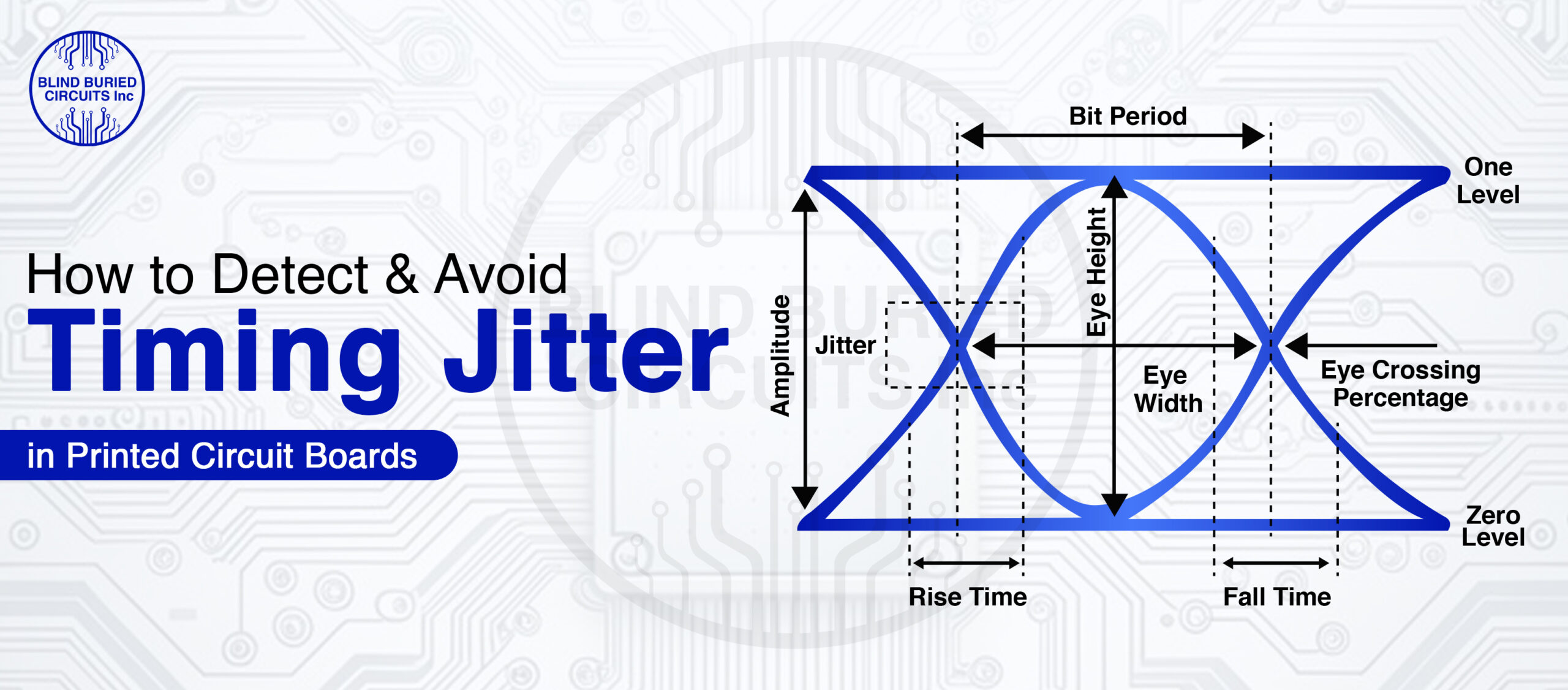
Timing jitter refers to the small but critical deviation in the arrival time of a signal’s rising or falling edges compared to its ideal position. These unpredictable variations, whether random or periodic, introduce uncertainty in data sampling and can compromise signal reliability.
At high speeds, even picosecond-level errors can disrupt communication. That’s why many businesses partner with blindburiedcircuits , we are here to ensure their PCB designs are optimized for signal integrity right from the start.
Causes of Timing Jitter
Key contributors to timing jitter include:
- Power supply noise due to insufficient decoupling capacitors

- Crosstalk from adjacent high-speed traces

- Temperature changes and component aging
- Poor PCB stack-up or grounding issues
Types of Timing Jitter
To fully understand timing behavior, engineers distinguish between deterministic jitter and random jitter.
Deterministic jitter – has identifiable causes such as crosstalk, electromagnetic interference, or duty-cycle distortion and can usually be minimized through careful PCB design.

- Random jitter – arises from thermal noise or other stochastic processes and follows a Gaussian distribution, making it less predictable but still measurable.
Recognizing these types early helps in selecting the right measurement technique and mitigation strategy.

Impact on Signal Integrity
The effects of jitter in clock signals can be severe. In high-speed designs such as DDR memory, Ethernet, and PCIe systems, even minimal clock jitter can distort data signals, causing bit errors and reducing system reliability. Left unaddressed, this instability may shorten product lifespan or lead to costly field failures.
2. How to Measure and Analyze Jitter in PCBs
Observation is the first step to prevention. Engineers frequently ask how to measure jitter. Here’s a structured approach:
Identify Critical Signal Paths
Start by identifying high-speed and sensitive signals where timing jitter is most likely to occur like clock distribution networks, DDR interfaces, or high-speed serial channels. Mapping these areas early ensures focus on the spots that are most vulnerable nodes.
Use Correct Instruments to Measure Jitter
To accurately measure jitter, employ high-bandwidth oscilloscopes or time-interval analyzers.
- Use differential probes to reduce external noise.
- Capture long acquisition windows to detect rare spikes.
- Apply statistical tools (e.g., RMS and peak-to-peak calculations) to fully characterize jitter.
Interpret Data and Define Acceptable Limits
Finally, compare measured jitter against application-specific standards such as PCIe or Ethernet. Most high-speed designs target jitter levels below 1% of the unit interval. Understanding how to interpret results correctly prevents expensive redesigns and ensures compliance with industry requirements.
3. Proven Strategies to Reduce and Avoid Timing Jitter
Once timing jitter is quantified, the next step is mitigation. Proven strategies include:
- PCB Layout and Decoupling
Carefully route high-speed signals and maintain controlled impedance. Place decoupling capacitors close to power pins to suppress voltage ripple and noise. This reduces both power supply noise and the risk of clock jitter.
- Custom PCB Manufacturing
Partner with an experienced custom PCB manufacturing service to guarantee tight layer stack-ups, precise trace widths, and controlled impedance. High-quality fabrication helps eliminate microscopic variations that can cause jitter.
- Power Delivery and Grounding
Use low-impedance power delivery networks and multiple ground vias to stabilize reference potentials. Robust grounding prevents the current loops that often lead to jitter.
- Thermal Management
Maintain stable board temperatures with proper heat dissipation. Thermal drift can shift timing and introduce jitter in clock signals.
By combining these methods, engineers can dramatically reduce timing jitter, ensuring stable and reliable PCB performance.
4. Real-World Best Practices and Common Mistakes
Best Practices
Industry leaders consistently demonstrate that a combination of precise design and advanced custom PCB manufacturing yields exceptional results.
- High-speed networking equipment often uses stacked microvia PCBs with carefully designed return paths to eliminate jitter-causing reflections.
- RF circuits benefit from well-placed decoupling capacitors and shielded layers to maintain clean clock signals.
Common Mistakes
Despite these best practices, common pitfalls persist:
- Ignoring Power Supply Noise: Skipping or misplacing decoupling capacitors lets voltage ripple directly cause jitter.
- Poor Signal Termination: Failure to match impedance can create reflections and errors.
- Improper Measurement: Not knowing how to measure jitter accurately may hide critical problems until late in the design cycle.
By avoiding these mistakes and leveraging proven strategies, engineers can safeguard their designs against the hidden threat of clock jitter.
Avoid these costly mistakes. Contact Our expertise sales engineers at sales@blindburiedcircuits.com to review your design before production
Conclusion
Mastering timing jitter management is no longer optional; it is essential for reliable, high-performance PCBs. Start by identifying crucial signal paths and learning to measure jitter with precision. Then implement robust design practices: place decoupling capacitors strategically, ensure proper grounding, and use controlled impedance.
Partnering with trusted custom PCB manufacturing providers like blindburiedcircuits ensures these design choices translate into production quality, keeping clock jitter signals well within acceptable limits.
By combining accurate detection, proven mitigation strategies, and high-quality fabrication, engineers can build PCBs that deliver exceptional speed, stability, and long-term reliability.