

SMT is everywhere now. It powers phones, appliances, medical devices, cars, and industrial controls. It is fast, repeatable, and great for compact designs. These are real advantages of SMT. But SMT is also unforgiving. Tiny mistakes can create significant defects.
Many teams only notice SMT mistakes after the worst moment.
A batch fails testing, the schedule slips, costs rise, and confidence drops.
At Blind Buried Circuits, readers often want one thing. A clear list of what goes wrong in SMT and how to prevent it. This blog does exactly that.
You will learn eight common SMT mistakes in pcb manufacturing and assembly. You will also learn simple ways to avoid them, even if you are not an expert.
Why The Advantages Of SMT Still Require Careful Process Control
The advantages of SMT are clear:
- Smaller boards and lighter products
- Faster automated placement
- Better high-frequency performance in many designs
- Lower cost at scale when the process is stable
But SMT depends on many steps working together.
Solder paste printing, placement, reflow heat, and inspection all have to match your board design.
If one step is off, defects can show up as:
- Intermittent failures
- Random shorts
- Weak joints that crack later
- Low yield that forces rework
That is why preventing SMT mistakes is one of the fastest ways to improve quality and reduce waste.
Mistake 1: Using Incorrect Footprints And Land Patterns
Footprints look “fine” in the CAD tool.
But even a small footprint error can cause significant issues in pcb manufacturing and assembly.
Why This Mistake Causes Defects
A footprint that is too tight or too loose can lead to:
- Solder bridges between pins
- Opens because the pads do not wet correctly
- Weak joints that fail after vibration
- Parts that shift during reflow
This is very common with:
- QFN packages
- Fine-pitch ICs
- Tiny resistors and capacitors
How To Avoid It
Use these PCB layout improvement tips:
- Always verify footprints against the component datasheet
- Use trusted libraries and control who can edit them
- Check pad sizes, pad spacing, and courtyard clearance
- Run a footprint review before you release files
A footprint review takes minutes but a footprint mistake can cost weeks.

Mistake 2: Poor Stencil And Solder Paste Volume Control
Solder paste printing is the start of most solder joint quality.
If the paste is wrong, the joints are wrong.
What Goes Wrong
- Too much paste leads to bridging
- Too little paste leads to opens or weak joints
- Uneven paste leads to tombstoning
Tombstoning is when one side of a small part lifts like a little tower.
It usually happens because one pad heats or wets faster than the other.
How To Avoid It With Simple Checks
- Use the correct stencil thickness for your smallest parts
- Use reduced paste openings for fine pitch when needed
- Avoid placing tiny passives in areas with extreme copper imbalance
Consider solder paste inspection (SPI) for tight builds

Mistake 3: Bad Component Orientation And Polarity Marking For A PCB Assembly Company
Polarity mistakes are painful because they can be invisible.
A board may look perfect, but fail instantly.
What Goes Wrong
Common errors include:
- Diodes reversed
- LEDs reversed
- Electrolytic capacitors reversed
- IC pin-1 rotation mistakes
This is one of the most common reasons a pcb assembly company sees “dead on arrival” boards.
How To Avoid It
Use these PCB layout improvement tips:
- Keep consistent orientation rules across the whole board
- Use clear pin-1 and polarity marks in silkscreen
- Ensure the BOM and pick-and-place file match the CAD orientation
- Add assembly notes that show polarity clearly
A simple polarity legend on the board can save a lot of time.

Mistake 4: Not Designing For Pick-And-Place And AOI
SMT lines rely on machine vision.
If you do not design for that, placement and inspection become harder.
What Goes Wrong
- Missing fiducials cause placement drift
- Very tight placements make inspection unreliable
- Tall parts block cameras from seeing small joints
- Parts near the edge may shift during conveyor movement
How To Avoid It
Use these PCB layout improvement tips:
- Add global fiducials and local fiducials for dense areas
- Keep space around fine-pitch parts for AOI viewing
- Keep tiny parts away from very tall parts if possible
- Keep sensitive parts away from breakaway edges and rails
When your board is AOI-friendly, defect detection improves.
That lowers rework and improves yield.

Mistake 5: Poor Reflow Profile And Thermal Imbalance
Reflow soldering is not “set it and forget it.”
Different boards need different heat behaviour.
What Goes Wrong
- Cold joints from insufficient heat
- Overheating damage to components
- Warpage that stresses joints
- Voids under thermal pads
- Solder balls and messy joints
Boards with heavy copper, large ground planes, and mixed component sizes need special care. Thermal imbalance is a common reason one area sells well while another struggles.
How To Avoid It With Practical Steps
- Profile the oven for your board type and component mix
- Place temperature test points on early builds
- Avoid extreme copper imbalance when possible
- Use thermal relief on pads tied to large copper areas
This is one of those process areas where a good pcb board manufacturer and assembly partner can help by sharing profile guidance. But you still need to design with heat flow in mind.

Mistake 6: Ignoring Moisture Sensitivity And Storage Rules
Some parts absorb moisture from the air.
When heated in reflow, the moisture can expand and damage the package. This is often called “popcorning.”
What Goes Wrong
- Microcracks inside IC packages
- Delamination in the package
- Early-life failures that are hard to debug
This risk increases when:
- Parts are stored outside dry packs for too long
- Humidity control is weak
- Bake rules are ignored when needed
How To Avoid It
- Track moisture-sensitive part exposure time
- Store parts in dry packs with humidity indicators
- Bake parts when required by handling rules
- Keep humidity control in storage and staging areas
A careful pcb assembly company workflow treats storage as part of quality, not an afterthought.

Mistake 7: Weak DFM Rules For Mask, Spacing, And Paste
Many SMT defects are “design rule” defects.
They are not random. They are preventable.
What Goes Wrong
- Solder mask slivers peel or misregister
- Pads are too close, causing bridges
- Paste mask is not tuned for fine pitch
- Annular rings are too small, causing drill breakout risk
These issues often show up when a board is pushed to the limits without matching the fab’s rules.
How To Avoid It
Use these PCB layout improvement tips:
- Use a fab-specific DRC set that matches your chosen supplier
- Keep mask expansions reasonable and consistent
- Avoid excessively tight pad spacing unless truly needed
- Review DFM feedback before the first production run
Good DFM reduces surprises during manufacturing and assembly.

Mistake 8: Skipping Proper Inspection And Test Coverage
Some defects are easy to see.
Many are not.
If inspection and testing are weak, defects ship.
Then they return as warranty claims or field failures.
What Goes Wrong
- Hidden BGA defects pass visual checks
- Intermittent joints pass simple power-on tests
- Missing test points make debugging slow
- Minor defects become significant failures in the field
How To Avoid It
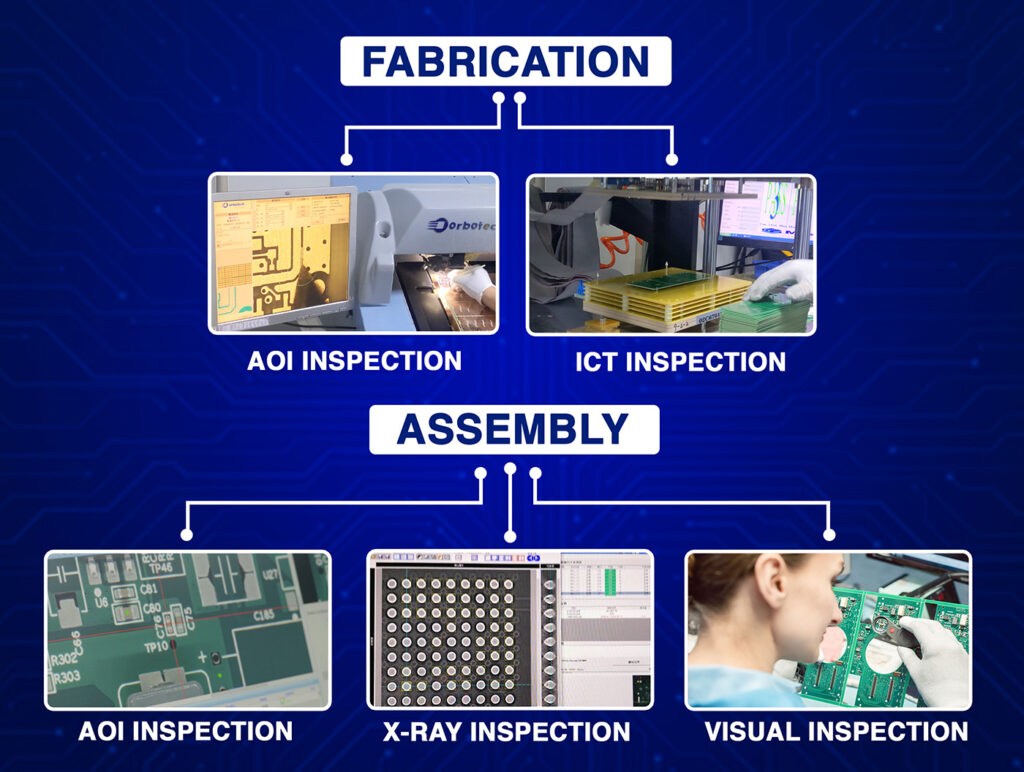
- Use AOI for most SMT boards
- Use X-ray for BGAs and hidden joints when needed
- Add test points for key rails and signals
- Use first-article inspection before scaling volume
- Track defects and use that feedback to improve the next run
This is a significant point where the advantages of SMT can be fully realised. SMT scales well only when inspection and test scales with it.
Quick Checklist Before You Send Files To A PCB Board Manufacturer
Use this short checklist as a final safety net:
- Footprints verified against datasheets
- Polarity marks are clear and consistent
- Fiducials added for placement and inspection
- Spacing rules matched to fab and assembly limits
- Stencil plan reviewed for fine pitch and small passives
- Reflow profile needs to be identified for heavy copper areas
- Moisture-sensitive parts handling plan confirmed
- AOI, X-ray, and test strategy defined
This checklist can prevent the most common SMT surprises.
Conclusion
SMT works best when small details are treated like big priorities. Footprints, paste, placement, heat, cleanliness, and inspection all connect. If one is weak, defects rise.
When you avoid these eight mistakes, you improve yield, reduce rework, and protect reliability. You also make your team faster, because fewer surprises mean fewer delays.
If you want to keep learning practically, Blind Buried Circuits is a valuable reference for connecting SMT decisions to real outcomes in pcb manufacturing and assembly.
FAQs
1: What Is The Most Common SMT Issue In PCB Manufacturing And Assembly?
In PCB manufacturing and assembly, one of the most common SMT issues is incorrect footprints causing bridges or openings.
2: How Can A PCB Board Manufacturer Help Reduce SMT Defects?
A PCB board manufacturer can help reduce SMT defects by sharing fab limits and DFM feedback early, and working with your PCB board manufacturer to match mask, spacing, and stack-up rules reduces build surprises.
3: What Should I Ask A PCB Assembly Company Before Production?
Before choosing a PCB assembly company, ask about AOI, X-ray for BGAs, reflow profiling, and moisture handling, because a careful PCB assembly process directly improves yield and reliability.
4: What Are The Real Benefits Of SMT For Production?
The advantages of SMT include faster automated placement and better scaling for volume, and are best achieved when stencil, placement, reflow, and inspection are controlled.