

Objective
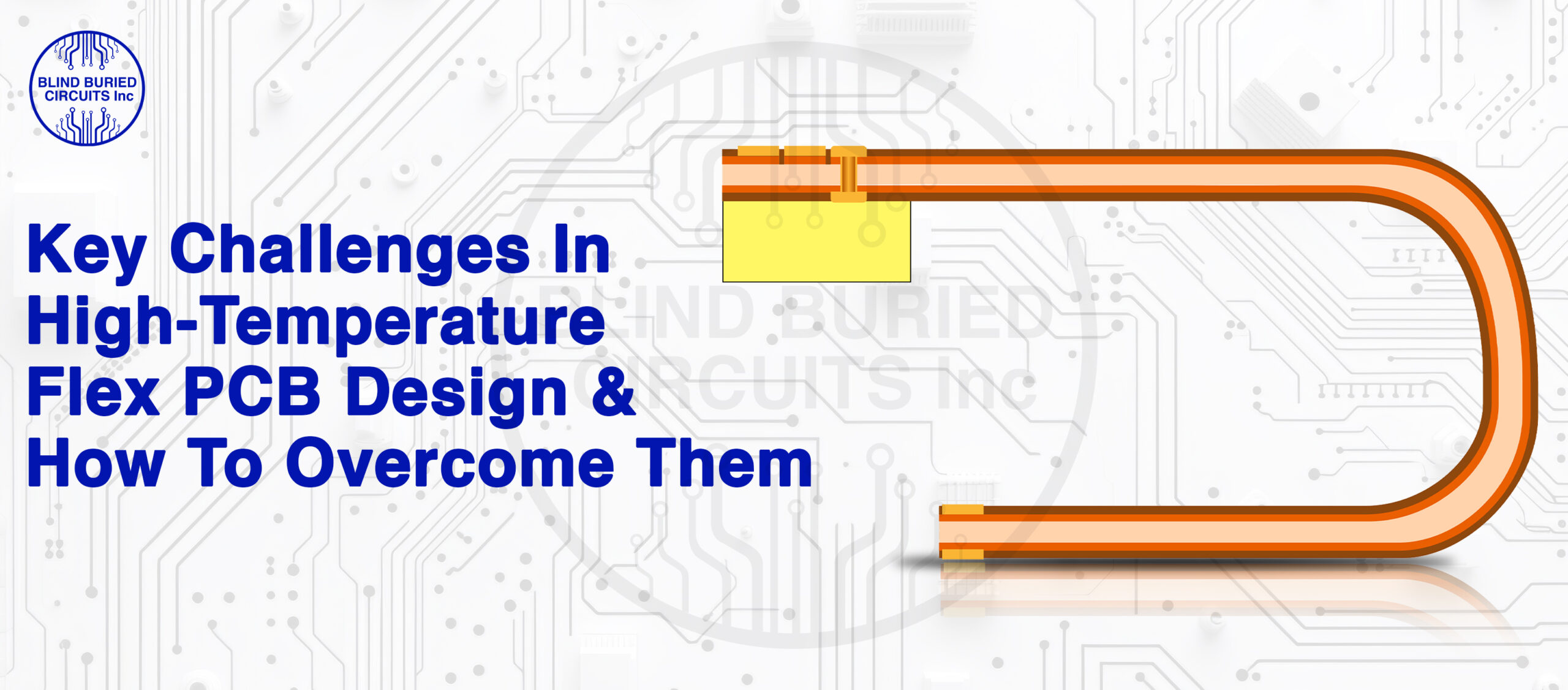
This guide explains the real design and manufacturing problems that come with building a high-temperature flex PCB. The focus is not just on heat by itself. The real issue is what heat does over time. It changes how materials behave. It adds stress to copper. It affects bonding, bending, and long-term stability. That is why this article looks at the full picture: materials, layout, bending zones, assembly limits, and flexible PCB thermal management. It also explains why these issues matter even more in harsh uses such as flex PCBs in satellite applications, where repair is not an option.
Key Takeaways
- A high-temperature flex PCB must deal with heat, movement, and long service life at the same time.
- Polyimide-based flex materials are common because they offer strong thermal resistance and good mechanical stability.
- Poor flexible PCB thermal management can lead to overheating, material damage, and shorter board life.
- Bend areas are one of the most sensitive parts of any flex design, especially under repeated heat cycles.
- Adhesiveless and all-polyimide constructions are often preferred for higher reliability flex work because they reduce some bonding risks.
- Flex PCBs in satellite applications need extra care because they face major temperature swings, vibration, and no field repair.
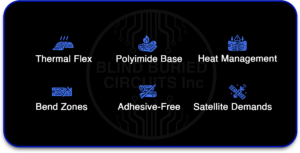
Table Of Contents
- What Makes a High-Temperature Flex PCB Different
- Why Heat Becomes A Bigger Problem In Flex Circuits
- Material Selection for High-Temperature Flex PCB Reliability
- Flexible PCB Thermal Management And Heat Control
- Bending Stress, Copper Fatigue, And Crack Risk
- Adhesives, Coverlay, And Layer Bonding Problems
- Assembly And Soldering Challenges In High Heat Designs
- Why Flex PCBs In Satellite Applications Need Extra Care
- Practical Ways To Improve High-Temperature Flex PCB Designs
- Key Takeaways
- FAQs
What Makes a High-Temperature Flex PCB Different
A flexible board already has a harder job than a rigid board. It must carry signals and power while also bending, folding, or fitting into tight spaces. Once high heat is added, the job becomes much harder. Materials expand and contract. Copper sees more stress. Bond lines are tested more often. In short, the board has to stay electrically stable while also surviving mechanical strain.
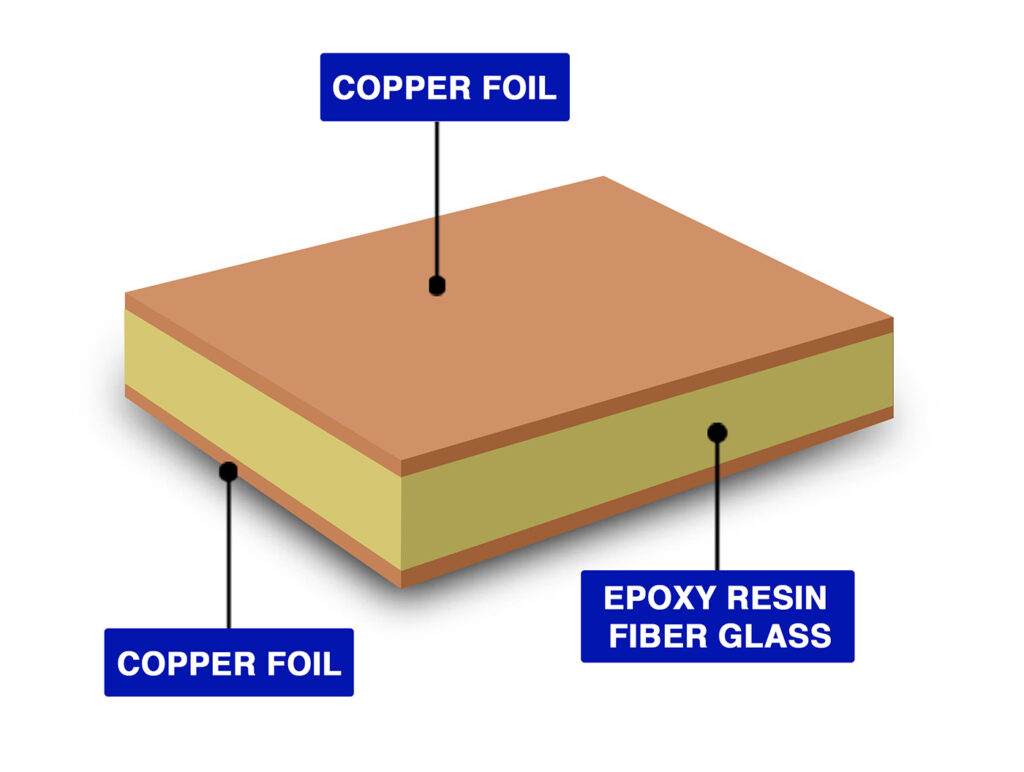
A high-temperature flex PCB is usually built with materials that can handle stronger thermal stress than standard constructions. Polyimide is a common choice because it offers good thermal resistance and dimensional stability, which means it holds size and shape better during heat exposure and assembly. DuPont’s flexible laminate data also describes all-polyimide constructions as suitable for high-temperature assembly and severe-environment use.
That matters because a flex board is not only judged by whether it works on day one. It is judged by whether it still works after many heat cycles, bends, and operating hours.
Why Heat Becomes A Bigger Problem In Flex Circuits
Heat is a problem in all electronics, but flex boards have less material mass and less natural heat spreading than many rigid designs. That means hot spots can build up faster if the layout is careless. Heat also does more than raise temperature. It changes the stress balance inside the board. Copper expands. Films move. Bonding layers are tested again and again.
This is why flexible PCB thermal management cannot be treated as a late-stage fix. It has to be part of the design from the start.
Common heat-related problems include:
- copper fatigue in stressed areas
- local overheating near power parts
- Weakening of bonded layers
- drift in electrical performance
- shorter service life after repeated thermal cycling
Those failure paths are well aligned with NASA and high-reliability PCB guidance that stresses the effect of thermal cycling and vibration on traces and interconnect quality.
Material Selection for High-Temperature Flex PCB Reliability
If the material choice is wrong, the rest of the design often struggles, no matter how good the routing looks.
For a high-temperature flex PCB, the base film needs to stay stable under both operating heat and assembly heat. Polyimide is widely used because it resists higher temperatures better than many other flexible materials and supports demanding flex fabrication processes. DuPont’s Pyralux data highlights thermal resistance to high-temperature assembly and good dimensional stability, both of which are important in harsh-use flex circuits.
Material choice should consider:
- operating temperature range
- assembly temperature exposure
- bend life needs
- dimensional stability
- bond strength over time
- compatibility with coverlay and adhesive systems
Another important point is adhesive use. Some flex constructions use adhesives between layers, while others use adhesiveless materials. IPC-related rigid-flex guidance notes that adhesiveless flex cores can improve flexibility and remove some adhesive reliability concerns. That can be very helpful in designs that face both heat and repeated movement.
So the material decision is not only about “can it survive heat.” It is also about “can it survive heat and movement together?”
Flexible PCB Thermal Management And Heat Control
Good flexible PCB thermal management is about spreading, moving, and reducing heat before it creates damage. Flex circuits do not always allow the same thermal tools as thick, rigid boards, so the layout has to do more work.
Practical methods include:
- wider copper where the current is higher
- better spacing around hot parts
- placing hot components away from bend zones
- using thermal paths into stiffer or supported areas when possible
- reducing crowding in one small section of the circuit
We at Blind Buried Circuits recommend thermal vias, heat sinks, high-Tg materials, and smart component placement for rugged PCB work, and those same principles matter in flex-related thermal planning where the design allows them.
The key is simple. If heat stays trapped, the board ages faster. If heat is spread and controlled, the board lasts longer.
Bending Stress, Copper Fatigue, And Crack Risk
This is one of the biggest practical problems in flex design.
A flex circuit is meant to bend, but not every part of it should bend, and not every bend should be sharp. When copper is forced through tight bend radii, especially under repeated temperature change, it can fatigue and crack. NASA’s flex circuit material notes also describe flex circuits as suitable for dynamic applications, but their reliability depends on proper design for repeated movement.
Important design habits include:
- Use larger bend radii instead of sharp folds
- Keep vias out of bend zones
- Avoid placing pads and solder joints in areas that move
- route traces with room to flex
- Spread conductors instead of packing them too tightly in moving areas
Guidance tied to IPC rigid-flex practice also warns that holes and vias near transition or stress areas can create reliability issues, and that construction choices like selective coverlay can improve reliability.
In plain terms, many flex failures do not start as dramatic heat failures. They start as small cracks in stressed copper that slowly become open circuits.
Adhesives, Coverlay, And Layer Bonding Problems
People often focus on copper first, but bonding layers matter just as much.
In a high-temperature flex PCB, the bond between layers must survive fabrication, assembly, and real operating heat. If that bond weakens, the board may blister, lift, or lose mechanical integrity. This is one reason all-polyimide constructions are valued in severe-environment designs. DuPont’s laminate information specifically connects these materials to demanding applications and strong thermal performance.
Coverlay choice matters too. It protects the copper, but it must also handle flexing without creating stress concentration. IPC-related flex guidance highlights selective coverlay as a more reliable approach in some rigid-flex cases compared with older full-board methods.
In practice, designers should ask:
- Will this bond line stay strong after repeated heat exposure?
- Does the coverlay support the movement or fight against it?
- Is the construction too thick for the bend requirement?
These are small questions early in design, but they become big problems later if ignored.
Assembly And Soldering Challenges In High Heat Designs
High-temperature flex work also has to survive assembly. That means the board must tolerate soldering temperatures without shifting too much, shrinking unevenly, or stressing bonded layers.
This is another reason thermal resistance and dimensional stability are so important in flex materials. DuPont’s flex laminate data describes strong compatibility with high-temperature assembly processes, which is a key requirement in this kind of design.
Assembly risks often include:
- pad lifting
- distortion during processing
- bond weakness after heat exposure
- Damage from poor support during soldering
- warping in very thin constructions
A board that passes design review but struggles in assembly is not a successful design. Layout, material, and build method all need to match.
Why Flex PCBs In Satellite Applications Need Extra Care
Flex PCBs in satellite applications face some of the hardest conditions in electronics. Space systems may see severe temperature swings, vibration during launch, and long life without repair access. That is why satellite flex boards need:
- stable high-temperature materials
- low-risk bonding systems
- strong resistance to thermal cycling
- careful control of vibration-sensitive areas
- proven construction, not experimental shortcuts
In this setting, “good enough” is not enough. If a flex circuit fails in orbit, there is no easy fix. That forces designers to be more disciplined about heat, stress, and material behavior.
Practical Ways To Improve High-Temperature Flex PCB Designs
A reliable high-temperature flex PCB usually comes from disciplined basics, not from one clever trick.
Use this checklist:
- Choose polyimide-based or similarly suitable high-temperature materials where the environment demands it
- Consider adhesiveless or all-polyimide constructions for stronger reliability in harsh use
- Plan flexible PCB thermal management early, not after layout is complete
- Keep hot components out of moving sections
- Use generous bend radii
- avoid vias and solder joints in bend zones
- match the coverlay and construction thickness to the true bend need
- test prototypes under thermal and mechanical conditions close to real use
That last point matters a lot. Reliability is not something you assume. It is something you prove through realistic build and test work. IPC and NASA-related reliability resources both support that mindset for flex and high-reliability electronics.
Conclusion
If you are developing flexible circuits for harsh environments, working with an experienced engineering and manufacturing partner can make a significant difference. Blind Buried Circuits supports advanced PCB development with expertise in complex designs, precision manufacturing, and reliability-focused processes. Their team understands the technical challenges involved in high-performance flexible circuits and works closely with engineers to turn complex designs into dependable hardware.
FAQs
What is a high-temperature flex PCB?
A high-temperature flex PCB is a flexible circuit built with materials and construction methods that can handle stronger heat exposure than standard flex circuits, often using polyimide-based systems for better thermal resistance and stability.
Why Is Flexible PCB Thermal Management So Important?
Because trapped heat can speed up material aging, raise electrical stress, and shorten board life. Good flexible PCB thermal management helps control hot spots and protects both the board and its components.
What Causes Cracks In Flex Circuits?
Common causes include tight bend radii, repeated movement, poor copper layout in moving areas, and heat-driven stress over many cycles.
Are Adhesiveless Flex Materials Better For High-Reliability Designs?
They often are, because they remove some adhesive-related reliability concerns and can improve flexibility in demanding designs.
Why Are Flex PCBs In Satellite Applications So Demanding?
They face strong temperature swings, launch vibration, and long operating life with no repair access once deployed.