

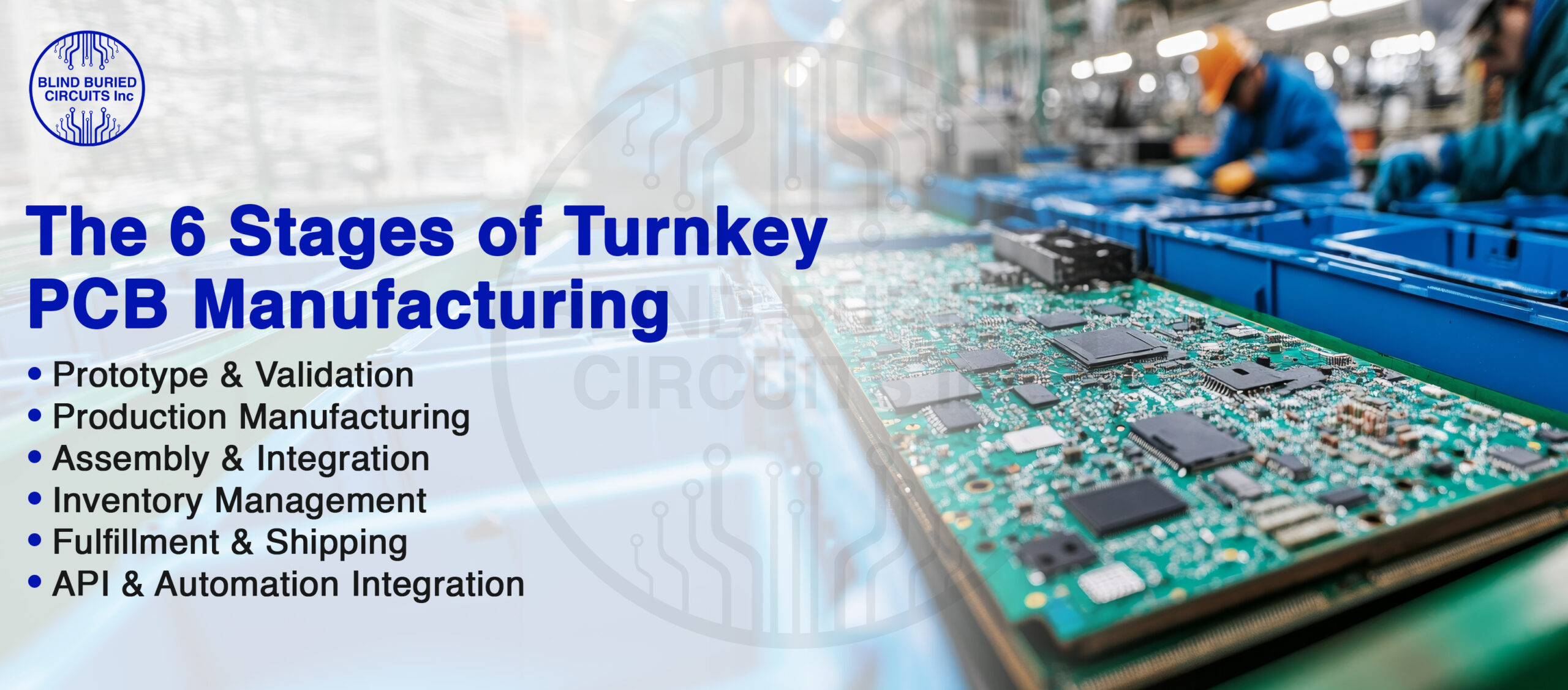
Understanding each stage of turnkey PCB manufacturing helps you control costs, shorten build time, and avoid common mistakes that slow down hardware teams.
Objective
This article explains the full turnkey PCB manufacturing workflow in six clear stages. You will learn what happens at each step, what details matter most, and what to check so your boards come back buildable, testable, and consistent.
Key Takeaways
- “Turnkey” means one partner manages fabrication, parts, assembly, testing, and delivery.
- Most delays start from unclear files, weak BOM rules, or late design checks.
- A clean prototype stage reduces the need for expensive redesign later.
- Sourcing is a quality risk when substitutions are not controlled.
- Assembly quality improves when inspections happen during the build, not only at the end.
- Inventory and shipping decisions affect cost and reliability more than many teams expect.
- Automation matters when order volume grows, and manual tracking becomes messy.

Table of Contents
- Introduction
- What “Turnkey” Means in PCB Manufacturing
- Stage 1: PCB Prototyping and Design Validation
- Stage 2: Full-Scale Turnkey PCB Manufacturing
- Stage 3: Circuit Card Assembly and Device Integration
- Stage 4: Inventory Storage and Lifecycle Management
- Stage 5: Order Fulfillment and Global Shipping
- Stage 6: System Integration Through APIs and Automation
- Conclusion
- FAQs
Introduction
Hardware teams move fast today, but the build chain still has many moving parts. You have the board itself, the parts list, assembly rules, inspection needs, and shipping requirements. If these pieces are split across multiple vendors, small gaps can lead to significant delays.
This is why turnkey PCB manufacturing matters. It puts one partner in charge of the full flow, so sourcing and assembly planning happen together.
What “Turnkey” Means in PCB Manufacturing
In turnkey pcb manufacturing, the manufacturer takes responsibility from your release package to delivery. You provide the design files and requirements, and the partner manages fabrication, components, assembly, test steps, packaging, and shipment.
This is different from a setup where you buy parts yourself and ship them to an assembler. It is also distinct from using one shop for fabrication and another for assembly, which can work but usually adds coordination overhead.

Turnkey vs consigned vs partial turnkey
These terms show up in quotes, so it helps to keep them simple.
- Turnkey: the partner sources parts and builds.
- Consigned: you supply parts, the partner assembles.
- Partial turnkey: you supply some parts, and the partner sources the rest.
Partial turnkey is common when you already hold inventory, or when a few parts must come from an approved channel for warranty or compliance reasons.
Key advantages of turnkey PCB assembly for product teams
The advantages of turnkey PCB assembly are practical, not theoretical. You often see them with fewer delays and fewer vendor conflicts.
Most teams notice:
- A simpler supply chain with fewer handoffs
- Faster decisions when a part is out of stock
- Clear ownership when a quality issue appears
- Less time spent on purchase orders and shipping coordination

The Six Core Stages of Turnkey PCB Manufacturing
Stage 1 – PCB Prototyping and Design Validation
Why prototypes matter in the PCB fabrication and assembly process
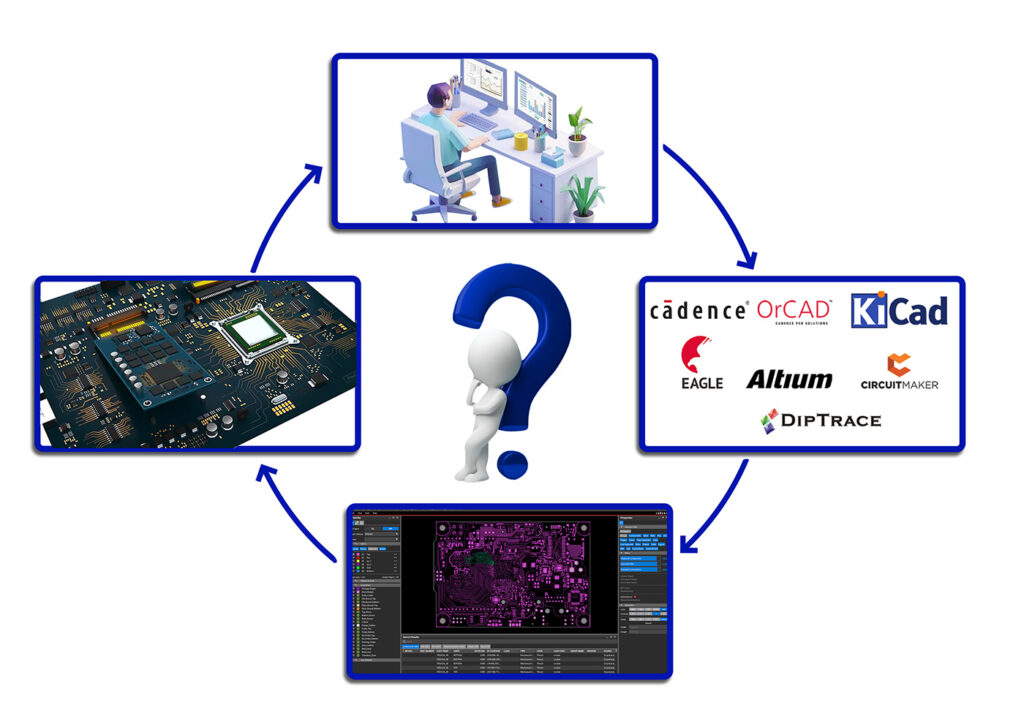
A prototype build is where you learn what the design does in real life, not only in CAD. It also tells you whether the design is buildable without special handling. This is a big deal, because “works once” is not the same as “builds reliably.”
During prototyping, you validate things that often cause failures later:
- Footprints and pinouts match the real parts
- Polarity marks are clear for diodes, electrolytics, and LEDs
- Connectors match the enclosure and cable direction
- Thermal hotspots are manageable under load
- Test points are reachable with probes or fixtures
DFM checks, quoting, and early risk flags
A strong turnkey partner will run DFM checks early. These checks look for issues that can break fabrication or make assembly unreliable.
Proper DFM checks include:
- Trace width and spacing vs shop capability
- Drill sizes and copper clearance rules
- Solder mask sliver risk and mask-to-pad alignment
- Via rules, including tenting, filling, or via-in-pad needs
- Courtyard spacing for dense parts that need rework access
When these checks are done early, the rest of the PCB fabrication and assembly process runs more smoothly. You avoid last-minute changes that create confusion across files and revisions.

BOM clarity and component visibility
A clean BOM is a schedule tool. It is also a quality tool. Many prototype delays come from missing manufacturer part numbers, unclear alternatives, or mismatched packages.
A practical BOM review checks:
- Manufacturer part number and package type
- Tolerance, voltage rating, and temperature rating
- Lifecycle risk, such as NRND or EOL flags
- Approved alternates and substitution rules
- Special handling needs, like moisture sensitivity levels
Did you know? Many early failures are caused by footprint or polarity mistakes, not by the circuit idea itself. A quick prototype build often finds these issues faster than any document review.
Stage 2 – Full-Scale turnkey PCB manufacturing
Moving from prototype to production without losing control
Production is repeatable. To move cleanly from prototype to production, you need stable rules and locked documentation. This is where teams often slip, because they assume a successful prototype automatically means a stable production release.
A solid production release package usually includes:
- Final Gerbers and drill files
- Stackup notes and controlled impedance targets if needed
- Assembly drawings with clear polarity and pin-1 marks
- Pick-and-place data that matches the latest revision
- BOM with approved alternates and “no substitute” parts listed
- Test plan and acceptance criteria

Sourcing strategy and substitution discipline
Sourcing is not only about price. It is about getting the right part, from a traceable channel, with a clear rule for alternates.
In a good turnkey flow, substitution should be controlled like this:
- Alternates must match electrical specs and footprint
- Alternates must be approved before ordering
- Any last-minute change should trigger a review and sign-off
- The build record should capture the exact part used
This is one of the advantages of turnkey PCB assembly, because the same team that sources parts also owns the assembly outcome. That reduces the “procurement vs production” conflict that slows down.
Planning for yield, not only for quantity
When volume increases, you start caring more about yield. Yield is the percentage of boards that pass without rework. Yield depends on process choices like panelization, stencil strategy, and inspection gates.
Good planning usually includes:
- Panel layout that supports stable handling
- Fiducials and tooling holes for repeat placement accuracy
- Reflow profile control for your component mix
- Clear rework rules for fine-pitch parts and BGAs
Stage 3 – Circuit Card Assembly and Device Integration
What happens during the PCB fabrication and assembly process?
Assembly is the process by which the bare board becomes a working circuit. The core steps are usually solder paste printing, component placement, and reflow soldering. Through-hole parts may be added using selective soldering or wave soldering, depending on the design.
What matters here is process control. A board can look fine but still fail later if solder joints are weak, components are misaligned, or heat-sensitive parts are stressed during reflow.
Inspection and testing that catch issues early
Waiting until the end to test everything is risky. Quality improves when checks happen during the build.
Common quality gates include:
- Incoming inspection for critical parts
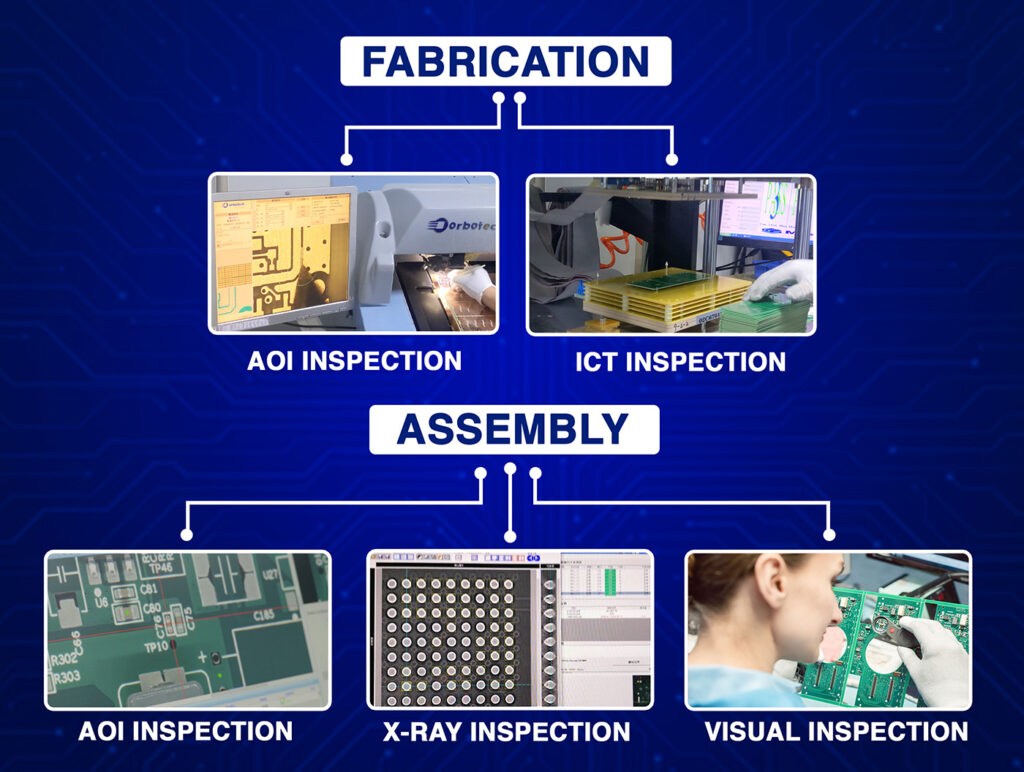
- AOI to catch placement, polarity, and solder joint issues
- X-ray inspection for hidden joints under BGAs and QFNs
- Electrical testing for opens and shorts
- Functional testing when a fixture and procedure exist

Device integration beyond the PCB
Some turnkey programs include more than the circuit card. They may consist of cable assembly, enclosure integration, labeling, and packaging. These steps matter when mechanical fit or connector strain can affect reliability.
If integration is included, you should confirm:
- Cable routing and strain relief expectations
- Torque specs for enclosure hardware
- Labeling rules and serial number format
- Packaging requirements for shock, ESD, and moisture control
Stage 4 – Inventory Storage and Lifecycle Management
Inventory risks that quietly increase cost
After production, you may not ship everything immediately. Inventory then becomes a risk area, especially for startups and OEMs with uneven demand.
Typical problems include:
- Too much finished stock is tying up cash
- Not enough stock when a customer order spikes
- Parts that go obsolete, forcing redesign
- Damage from poor ESD or moisture control
Warehousing and controlled storage practices
Manufacturer-managed storage can help, but only if storage is controlled. Good practice includes ESD-safe handling, moisture control for sensitive assemblies, and lot tracking to trace issues back to a build batch.
Lifecycle planning also matters. It helps to review high-risk parts and build an alternate plan before a shortage forces a rushed substitution.
Stage 5 – Order Fulfillment and Global Shipping
Packaging, labeling, and compliance details
Shipping is part of quality. A working board can still arrive damaged if the packaging is weak or the moisture protection is missing.
Fulfillment may include:
- ESD bags and proper cushioning
- Moisture barrier packaging when required
- Labeling, barcodes, and revision tracking
- Customs paperwork and region-specific compliance needs
Drop shipping and multi-channel distribution
Some builds ship directly to customers, distributors, or regional warehouses. This reduces extra handling steps and can lower damage risk, mainly when the manufacturer already controls packaging and labeling.
Stage 6 – System Integration Through APIs and Automation
When volume grows, manual ordering and manual status tracking become slow and error-prone. This is where system integration helps. It can connect your ERP, order system, and the manufacturer’s production updates.
Automation can support:
- Auto-reorder triggers when stock drops below a threshold
- Real-time production status visibility
- Shipping tracking pushed back into your system
- Better lot and serial traceability for returns and warranty cases
This stage does not change solder joints or the quality of the copper. It changes how cleanly you can run turnkey PCB manufacturing without adding a large operations team.
Conclusion
The six stages are easy to list, but they matter because each protects the next. Prototype checks reduce redesign. Production planning improves repeatability. Assembly inspection gates protect yield. Inventory and shipping practices protect what you already paid to build. Automation helps you scale without losing visibility.
When turnkey PCB manufacturing is done with clear files, disciplined sourcing, and strong inspection gates, the workflow becomes calmer and more predictable. Teams that already understand manufacturing details, including those who know Blind Buried Circuits, tend to value that predictability because it helps them focus on product performance rather than constant vendor coordination.
FAQs
1) What is turnkey PCB manufacturing, and what does it include?
Turnkey PCB manufacturing is an end-to-end service in which a single partner manages PCB fabrication, component sourcing, assembly, inspection, testing, packaging, and shipping. It includes both material and process control, so the build is easier to repeat.
2) What are the advantages of turnkey PCB assembly compared to consigned assembly?
The advantages of turnkey PCB assembly include fewer missing parts, faster coordination when a component is out of stock, and a smoother build plan, as the same team handles procurement and assembly under a single schedule.
3) How do you reduce risk in the PCB fabrication and assembly process before production?
You reduce risk in the PCB fabrication and assembly process by running DFM checks early, validating the BOM with approved alternates, confirming polarity and footprint accuracy, and defining inspection and test steps before the build starts.
4) When should a team move from prototype to turnkey production?
Move when the prototype passes key tests, the BOM is stable, and DFM feedback is resolved. This prevents prototype-level issues from repeating across a larger batch.
5) How should component substitutions be handled in turnkey builds?
Substitutions should follow written rules, require approval, match electrical specs and footprint, and be fully documented in the build record. This protects performance and reduces unexpected failures.