

Objective
This blog explains what PCB laminate materials are, the common types used in PCB manufacturing, their key properties, and how to choose the right material for different circuit board requirements. You’ll also learn how laminate selection can affect electrical performance, thermal stability, mechanical reliability, and overall PCB performance.
Key Takeaways
- PCB laminate insulates, supports, and separates copper layers.
- FR-4 is widely used for rigid PCBs due to its balanced performance and cost.
- High-speed and high-frequency circuits may need low-loss laminates with controlled dielectric properties.
- Flexible PCBs require laminates suited to bending, temperature, and electrical demands.
- Metal-based laminates improve heat dissipation in thermal-intensive applications.
- Choose the laminate based on electrical, thermal, mechanical, and manufacturing requirements.
Table Of Contents
- What Are PCB Laminate Materials?
- Why Are PCB Laminate Materials Important?
- Common Types of PCB Laminate Materials
- Important PCB Laminate Properties to Consider
- How PCB Laminate Materials Affect Performance
- How to Choose the Right PCB Laminate Material
- Common Challenges When Choosing PCB Laminates
- Why Choose Blind Buried Circuits for PCB Manufacturing?
- Frequently Asked Questions
What Are PCB Laminate Materials?
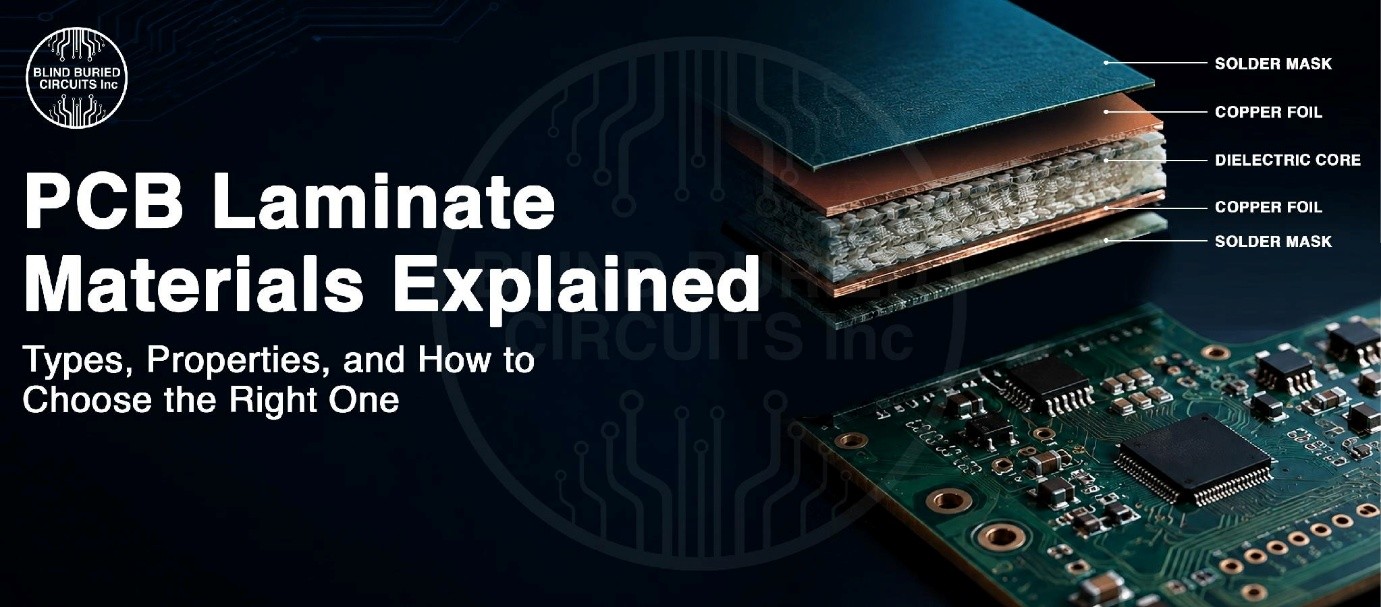
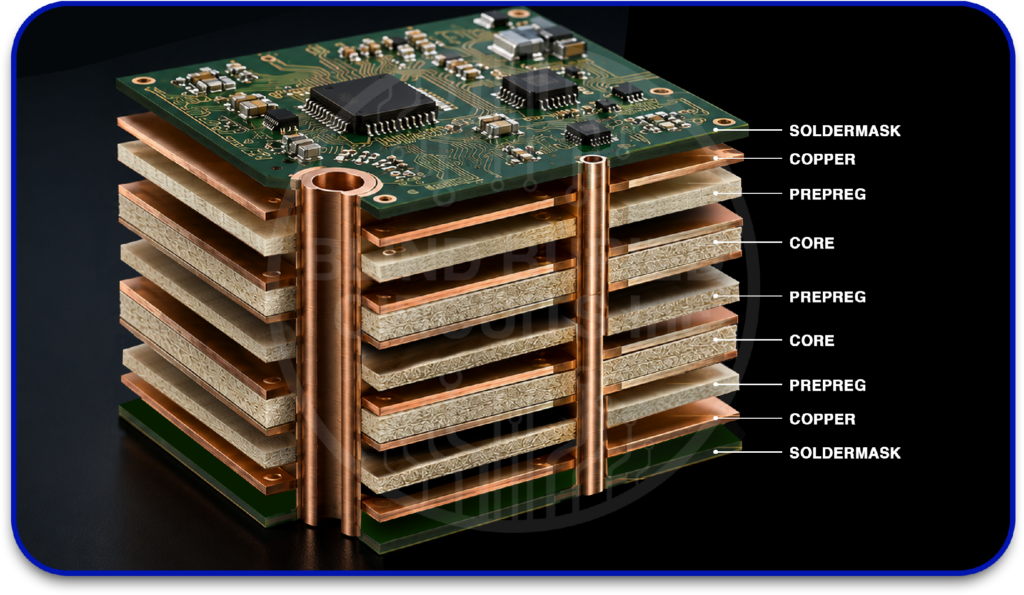
PCB laminate forms the insulating and mechanical foundation of a printed circuit board, but its role goes well beyond simply supporting copper. The laminate system influences controlled impedance, signal loss, thermal expansion, dimensional stability, via reliability, and how the board behaves during multilayer lamination and soldering.
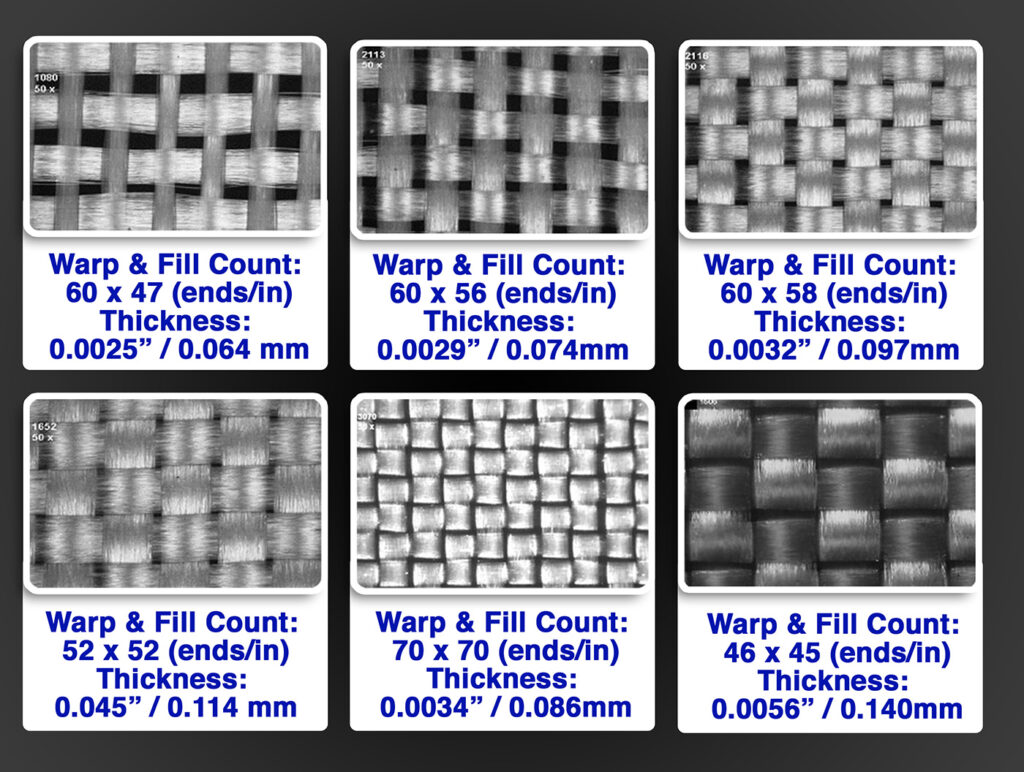
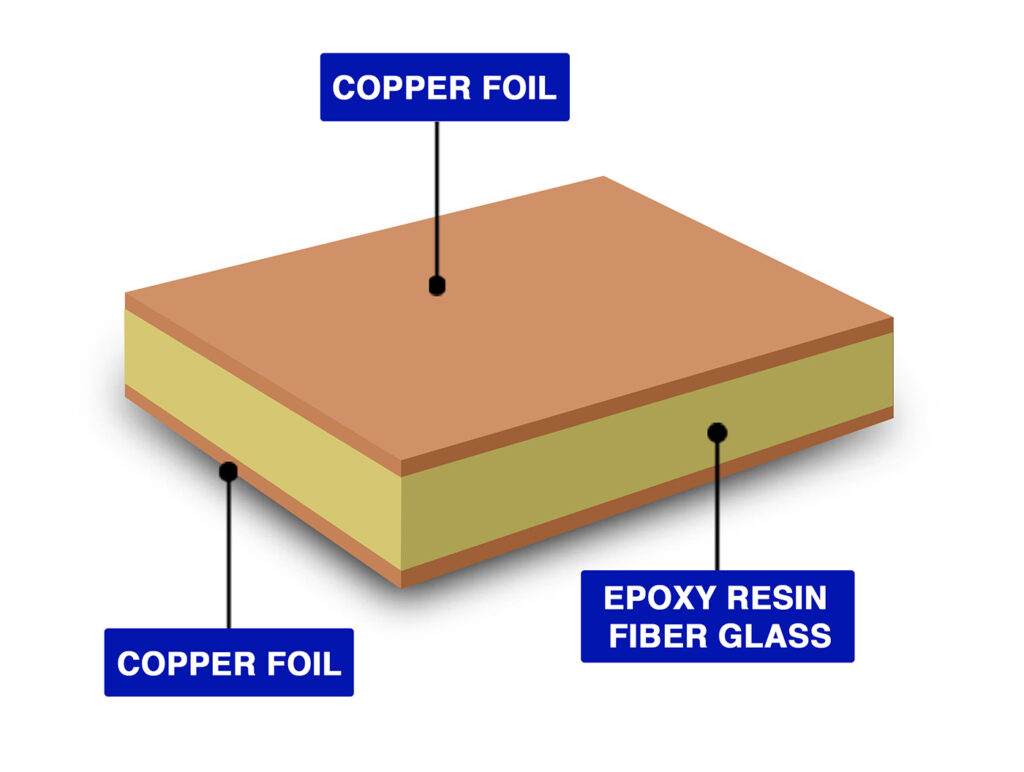
Rigid multilayer PCBs typically use cured laminate cores together with prepreg bonding layers. Copper-clad laminate (CCL) combines the dielectric laminate with copper foil that is subsequently patterned to form conductive circuitry.
Choosing the correct material therefore requires more than selecting FR-4 or a high-Tg PCB grade. Designers should consider dielectric properties, thermal characteristics, mechanical stability, PCB stack-up, fabrication processes, and the operating environment.
Why Are PCB Laminate Materials Important?
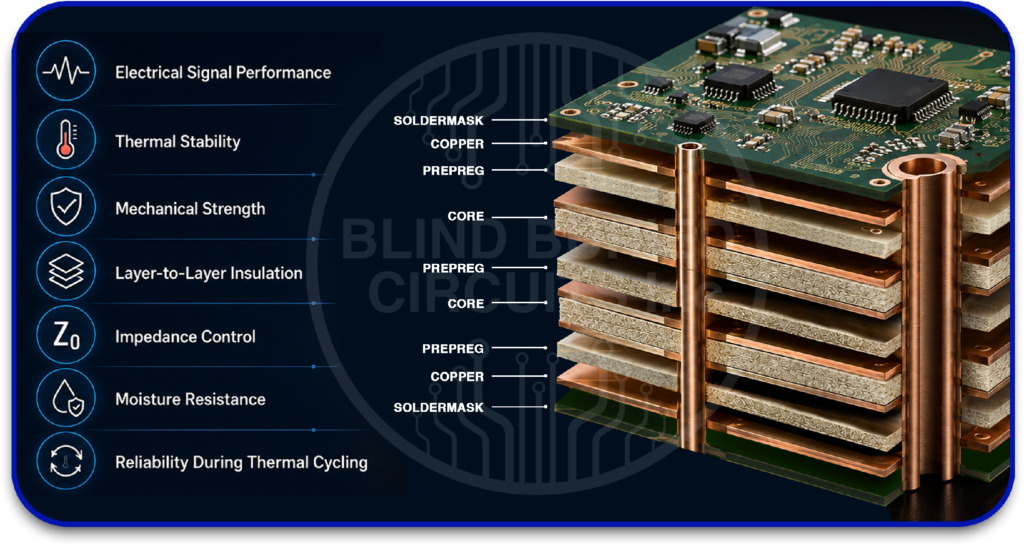
PCB laminate materials directly influence how a circuit board performs during manufacturing and operation.
The laminate can affect:
- Electrical signal performance
- Thermal stability
- Mechanical strength
- Layer-to-layer insulation
- Impedance control
- Moisture resistance
- Reliability during thermal cycling
For a standard digital circuit, a conventional FR-4 laminate may provide the required balance of performance and cost. A high-speed or RF design may require a specialized laminate with more controlled dielectric properties. Flexible circuits require materials that can withstand bending without compromising circuit reliability.
Selecting the wrong laminate for a Copper Clad Laminate PCB can create problems such as signal loss, impedance variation, thermal stress, or reduced mechanical reliability.
Common Types of PCB Laminate Materials
PCB laminate materials vary according to the electrical, thermal, mechanical, and physical requirements of the application. The most common types include FR-4, high-Tg, high-frequency PCB and high-speed, flexible, and metal-based laminates.
| PCB Laminate Type | Main Characteristics | Typical Applications |
| FR-4 Laminate | Balanced electrical, mechanical, thermal performance, and cost | General rigid PCBs, industrial electronics, consumer electronics, control systems |
| High-Tg FR-4 | Higher glass transition temperature and improved thermal performance | Higher-temperature and high-reliability PCBs |
| High-Frequency / High-Speed Laminate | Controlled dielectric properties, low signal loss, and stable electrical performance | RF, microwave PCB, and high-speed digital circuits |
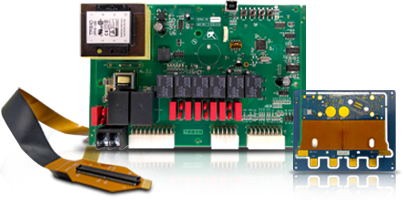
| Flexible Polyimide Laminate | Thin, flexible, and thermally stable; suitable for repeated or static bending | Flexible and rigid-flex circuits |
| Metal-Based Laminate | Improved heat dissipation through a metal base, commonly aluminum | LED lighting, power electronics, motor control, and thermal-intensive applications |
The right laminate should be selected based on the PCB’s electrical, thermal, mechanical, environmental, and manufacturing requirements.
For high-speed and RF designs, dielectric properties and signal loss are important, while flexible circuits require suitable bend performance. Thermal-intensive applications may benefit from metal-based laminate construction.
Important PCB Laminate Properties to Consider
When evaluating circuit board laminate materials, several properties should be reviewed before the PCB stack-up is finalized.
- Dielectric Constant (Dk): The dielectric constant affects how electrical signals travel through the PCB material. It is particularly important for controlled-impedance, high-speed, and RF designs.
- Dissipation Factor (Df): Dissipation factor indicates how much electrical energy is lost within the dielectric material. Lower-loss materials are generally preferred for demanding high-frequency and high-speed applications.
- Glass Transition Temperature: Tg indicates the temperature at which the resin system transitions from a rigid state toward a softer state. Higher-Tg materials can be useful when a PCB experiences elevated temperatures or repeated thermal exposure.
- Thermal Stability: The laminate must withstand the temperatures experienced during PCB fabrication, soldering, and normal operation without excessive degradation or dimensional instability.
- Moisture Resistance: Moisture absorption can affect electrical performance and dimensional stability. This becomes more important for PCBs operating in humid or demanding environments.
- Mechanical Strength: The laminate must provide enough mechanical stability to support the copper layers, components, vias, and other PCB structures throughout manufacturing and use.
- Coefficient of Thermal Expansion (CTE): CTE measures how much the laminate expands with temperature. High Z-axis CTE can increase stress on vias and plated-through holes during thermal cycling.
How PCB Laminate Materials Affect Performance
The selected laminate affects several aspects of PCB performance.
- For high-speed circuits, dielectric properties influence signal propagation, impedance, and loss. Using a material that does not match the electrical requirements can make it more difficult to maintain consistent signal performance.
- Thermal performance is also important. If the laminate is not suitable for the board’s temperature conditions, repeated heating and cooling can increase mechanical stress and reliability concerns.
- For multilayer PCBs, the laminate and prepreg system also contribute to the overall stack-up. Their thickness and dielectric properties affect layer spacing and controlled-impedance calculations.
- For flexible PCBs, the material must provide the required mechanical flexibility while maintaining electrical and thermal performance.
- This is why PCB laminate material selection should be considered during PCB design rather than treated as a final manufacturing decision.
How to Choose the Right PCB Laminate Material
The right laminate depends on the actual requirements of the PCB.
- Consider the Application: Start with the purpose of the circuit. A general-purpose control board may need a different material than an RF, high-speed, flexible, or thermal-intensive PCB.
- Review Electrical Requirements: For high-speed and RF designs, evaluate dielectric constant, dissipation factor, impedance requirements, and expected operating frequency.
- Check Thermal Requirements: Consider operating temperature, soldering and reflow exposure, thermal cycling, and the heat generated by components.
- Consider Mechanical Requirements: Rigid and flexible PCBs have different mechanical requirements. Flexible designs need materials and stack-ups that can withstand the required bending conditions.
- Match the Material to the Stack-Up: The laminate and prepreg system should work with the required layer count, dielectric thickness, copper weight, and impedance targets.
- Consider Manufacturing Availability: A technically suitable material must also be practical to manufacture. Material availability, fabrication capability, lead time, and cost can all affect the final PCB. Working with experienced PCB laminate manufacturers can help ensure the selected material is compatible with the required board construction and manufacturing process.
Common Challenges When Choosing PCB Laminates
- One common challenge is selecting a material based only on cost. A lower-cost laminate may not provide the electrical or thermal performance required by the application.
- Another challenge is choosing a laminate without considering the complete PCB stack-up. Material thickness, dielectric properties, copper weight, and layer arrangement all work together to determine PCB performance.
- High-speed designs can also become difficult when the laminate’s dielectric properties are not properly considered during impedance planning.
- For flexible circuits, selecting a material without considering bend requirements can reduce reliability over time.
- Working with an experienced PCB manufacturer during material selection can help identify these issues before fabrication begins.
Why Choose Blind Buried Circuits for PCB Manufacturing?
At Blind Buried Circuits, we support PCB manufacturing using a range of laminate and substrate options for standard and advanced circuit designs. Our material options include FR-4, high-Tg materials, Rogers, Nelco, Megtron, Panasonic, aluminum metal-clad, and copper-clad laminates.
We support multilayer PCB manufacturing with impedance control and lamination capabilities for complex board designs. Our PCB manufacturing capabilities also include HDI PCB, flexible, rigid-flex, and prototype PCBs, allowing laminate selection to be considered alongside the overall PCB construction.
If you need help selecting a circuit board laminate for your next PCB project, our team can review your design requirements and help determine a suitable material and stack-up.