


AI infrastructure is growing faster than most supply chains were built to handle.
Data centers are expanding. GPU clusters are being deployed at scale. Cloud providers are racing to add more AI computers. Every new server rack, GPU system, switch, accelerator, and power unit depends on printed circuit boards.
That is where the pressure is starting to show.
The boards used in AI infrastructure are not simple PCBs. They are high-layer, high-speed, high-power boards that need specific laminates, copper foil, prepreg, via fill materials, and surface finish chemicals. Many of these materials come from a limited supplier base.
So when AI infrastructure demand rises, the pressure quickly shifts to the PCB supply chain.
At Blind Buried Circuits, we see this issue directly with teams building AI hardware. The delays are real. They are getting longer. And in many cases, the delay is not caused by the PCB design itself. It starts with the materials needed to build the board.
Key Takeaways
- PCB material shortages are delaying AI infrastructure projects because demand for high-performance boards has outpaced supply.
- The biggest shortages are affecting low-loss laminates, heavy copper foil, high-Tg prepreg, HDI via fill materials, and precious-metal surface finish chemicals.
- PCB supply chain issues go beyond raw materials. High-layer fab capacity, CCL production, surface finish chemistry, and production queue time all affect delivery.
- PCB manufacturing delays are now adding months to some AI hardware programs. Boards that once took 6 to 8 weeks may now take 16 to 20 weeks or more.
- High-layer PCB availability is a specific AI infrastructure bottleneck. Boards with more than 20 layers require fewer capable fabs, and those fabs are heavily booked.
- AI hardware teams can reduce risk by involving PCB fabs early, checking material availability before design release, qualifying backup laminates, and planning around realistic lead times.
What Is A PCB Material Shortage?
A PCB material shortage occurs when laminate manufacturers, copper foil suppliers, prepreg producers, or specialty PCB material vendors cannot meet manufacturing demand within normal lead times.
In AI infrastructure projects, shortages are especially serious because many boards require low-loss laminates, high-Tg prepreg, heavy copper foil, HDI via fill materials, and precious-metal surface finish chemicals. These materials are not always easy to replace after a stack-up is finalized.
Why AI Infrastructure Is Creating Unprecedented PCB Demand
AI systems need more than chips. They need boards that can carry high-speed signals, support heavy power loads, manage heat, and run reliably in dense server environments.
That makes PCB design and PCB manufacturing much harder.
A normal commercial PCB may use 4 to 12 layers. An AI server board may use 16 to 24 layers. Some networking and accelerator boards go even higher. These boards also need tight impedance control, advanced laminates, and reliable thermal performance.
This is why AI infrastructure is putting unusual pressure on PCB material supply.
AI Server Motherboards
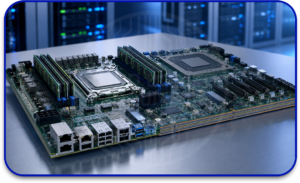
AI server motherboards carry fast signals between CPUs, GPUs, memory, storage, and networking interfaces.
They often use 16 to 24 layers. Some advanced designs need more. These boards must support high-speed interfaces such as PCIe Gen 5, CXL, and high-speed Ethernet.
Standard FR4 is often not enough for these designs. The signal loss can be too high. That is why many AI server motherboards need low-loss or ultra-low-loss laminates.
These materials are more expensive. They are harder to source. They also require strong process control during fabrication.
GPU Carrier Boards
GPU carrier boards are another major pressure point.
Modern GPUs draw very high power. Some high-end GPUs can draw 700 watts or more. The board must safely carry that power without overheating or reliability issues.
That often means using 2oz or 3oz copper layers. In some cases, heavier copper may be needed.
The challenge is simple. Heavy copper foil is not as widely available as standard copper foil. It also needs tighter control during production. When demand rises from AI hardware, EV systems, and industrial power electronics simultaneously, supply tightens quickly.

High-Speed Networking Hardware
AI clusters depend on fast networking.
Switch boards, optical module boards, and high-speed backplanes must move large amounts of data with low signal loss. Many of these designs use 112 Gbps lanes or higher.
At these speeds, laminate quality matters. Trace length matters. impedance control matters. Even small material differences can affect signal integrity.
That is why networking boards often need premium low-loss laminates. These are among the most constrained PCB materials right now.
Which PCB Materials Are Facing The Biggest Shortages?
The current PCB material shortage is not one single shortage. It is a group of shortages happening at the same time.
AI infrastructure has increased demand for several material categories that already had limited production capacity.
Low-Loss Laminates
Low-loss laminates are a major concern for AI hardware teams.
AI server boards and high-speed networking boards require materials that can carry high-speed signals with minimal insertion loss. Standard FR4 has a higher dissipation factor and is not suitable for many high-speed AI designs.
Materials such as Panasonic Megatron 6, Isola I-Tera MT40, Rogers 4350B, and similar low-loss materials are often used for these applications.
The problem is supply. These materials come from a smaller supplier base. Production capacity has not increased at the same speed as AI infrastructure demand.
Lead times that were once closer to 4 to 6 weeks can now stretch to 12 to 20 weeks at some suppliers.
Heavy Copper Foil
AI boards need strong power delivery.
That increases demand for heavy copper foil. Power layers carrying large current loads often need 2oz or 3oz copper. Some designs need more.
Heavy copper foil is harder to produce than standard 1oz foil. It must meet consistent thickness and quality requirements. Fewer suppliers can produce it at scale.
This creates a serious bottleneck when AI hardware, EV battery systems, and industrial power electronics are all competing for the same material.
High-Tg Prepreg
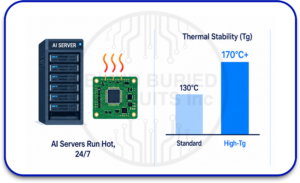
AI servers run hot. They operate in dense environments and often run continuously.
That means the board materials must withstand heat for extended periods. High-Tg prepreg, often above 170°C, is commonly used for better thermal stability.
Standard materials may not provide enough long-term reliability for these conditions.
High-Tg prepreg is also part of a limited supply chain. When server board demand rises, prepreg availability can directly delay PCB manufacturing.
HDI Via Fill Materials
AI boards often use HDI construction. This helps designers route dense signals through complex layouts.
HDI designs may use via-in-pad structures. These need conductive or non-conductive epoxy via fill materials.
These materials are not always available in large quantities. When many high-density AI boards move into production at the same time, the availability of fill material can tighten.
This can delay builds even when laminate and copper are already available.
Precious-Metal Surface Finish Chemicals
Many AI server boards use ENIG or ENEPIG surface finishes.
ENEPIG is often selected because it supports both soldering and wire bonding. It uses precious metals such as gold and palladium.
When precious-metal prices move or availability tightens, surface finish supply can also be affected.
This is not always the first delay engineers think about. But for certain AI boards, surface finish chemistry can become another supply chain risk.
PCB Material Shortage Comparison Table
| PCB Material Or Process | Why AI Boards Need It | Main Shortage Risk | Typical Impact On Projects |
| Low-loss laminates | Needed for PCIe Gen 5, CXL, 112 Gbps Ethernet, and other high-speed signals | Limited supplier base and long laminate lead times | Delays stack-up approval and board fabrication |
| Heavy copper foil | Needed for high-current power delivery on GPU and server boards | Fewer suppliers and rising demand from AI, EV, and industrial markets | Slows production of power-heavy boards |
| High-Tg prepreg | Needed for thermal stability in dense server environments | Limited availability of high-performance bonding materials | Increases material wait time before fabrication |
| HDI via fill materials | Needed for via-in-pad and dense routing | Tight supply of specialty epoxy fill materials | Delays HDI board fabrication |
| ENIG / ENEPIG chemicals | Needed for reliable surface finish and bonding support | Precious-metal price and availability pressure | Can delay finishing and final board delivery |
| High-layer PCB fab capacity | Needed for 20+ layer AI boards | Limited number of capable fabs | Creates long and unpredictable production queues |
Why PCB Manufacturing Delays Are Increasing In 2026
PCB manufacturing delays are increasing because material delays and fab capacity constraints are occurring simultaneously.
Even when one material is available, another may not be. Even when all materials are available, the fab may not have an open production slot.
This is why AI hardware schedules are becoming harder to predict.
What Are PCB Manufacturing Delays?
PCB manufacturing delays happen when a printed circuit board cannot move from design release to delivery within the expected production timeline.
In AI infrastructure projects, these delays are often caused by long lead time of laminate, limited high-layer fab capacity, material allocation, engineering changes, and extended testing for complex boards.
Laminate Lead Times
Low-loss laminate such as PTFE & CERAMIC substrates from manufacturers like ROGERS/TACONIC/ITEQ/EMCTW/MEGTRON/NELCO, their lead time is one of the biggest causes of delay.
If a board requires a specific laminate with a 16-week lead time, the fab cannot begin production until the material is available.
This can affect the entire hardware schedule.
A board originally planned for 8 weeks may move to 16 or 20 weeks because the material is not ready. If the design changes during that window, the material requirements may change as well. That can reset part of the process.
Fab Queue Constraints
Not every PCB fab can build AI infrastructure level boards.
High-layer PCBs need strong process control. They require accurate registration, controlled impedance, multiple lamination cycles, and careful plating.
The number of fabs capable of this work is much smaller than the number of fabs that can build standard boards. Those capable fabs are now busy with AI programs. Many are already committed to large customers. Smaller teams may have to wait longer for production slots.
High-Layer Manufacturing Bottlenecks
The higher the layer count, the more complex the build becomes.
A 24-layer board is not just a larger version of a 6-layer board. It has more lamination steps, greater registration risk, greater drilling complexity, more stringent plating control requirements, and a higher risk of yield loss.
That means high-layer boards take longer to build. They also leave less room for mistakes.
If a material arrives late or a production issue appears during fabrication, the delay can quickly grow from days to weeks.
Why High-Layer PCB Availability Is A Unique AI Infrastructure Problem
High-layer PCB availability issues affect AI infrastructure more than many other industries.
Most standard electronics do not need 20 to 32 layers. Consumer products, industrial controls, and many networking products often stay within 4 to 16 layers.
AI hardware is different.
AI server motherboards, GPU carrier boards, and high-speed switch boards regularly need 20 to 32 layers. Some advanced designs go above that.
At those layer counts, the available fab pool becomes much smaller.
| PCB Layer Count | Capable Fab Availability | Typical Lead Time In 2026 |
| 4 to 8 layers | Very large fab pool | 1 to 3 weeks |
| 10 to 16 layers | Large fab pool | 3 to 6 weeks |
| 18 to 24 layers | Smaller fab pool | 8 to 14 weeks |
| 26 to 32 layers | Very limited fab pool | 14 to 24 weeks |
| 32+ layers | Handful of capable fabs | 20+ weeks, often by allocation |
For AI programs working with 24- to 32-layer boards, the problem is not only the long lead time. It is uncertain.
For AI programs working with 24- to 32-layer boards, the problem is not only the long lead time. It is uncertain.
A fab may quote 14 weeks. Then a laminate delay, plating queue issue, or yield concern may push delivery to 20 weeks or more.
That uncertainty affects everything downstream. Testing gets delayed. Firmware validation gets delayed. System integration gets delayed. Data center deployment gets delayed.
What AI Hardware Teams Can Do To Reduce Supply Chain Risk
The supply chain will not fix itself quickly. But AI hardware teams can reduce risk by planning earlier and asking better questions. The most important step is to bring PCB supply chain planning into the design phase. Do not wait until the design is ready for release. By then, material choices are already locked, and options become limited.
- Start with the stack-up. Ask your PCB fab what materials are actually available now, not what the standard data sheet suggests. Ask about current lead times for the exact laminate, prepreg, copper weight, and surface finish your design needs.
- Qualify backup materials early. Many AI boards can use more than one laminate, but only if that option is reviewed during design. A backup laminate may still require signal integrity checks, stack-up changes, or re-simulation. It is much easier to handle this before release than after a shortage appears.
- Build realistic lead times into the project schedule. In 2026, 12 to 16 weeks for specialty laminates should be treated as a planning baseline for many AI boards, not a rare worst case.
- Work with fabs that understand high-layer AI boards. Ask if they hold safety stock for common high-performance laminates. Ask what layer counts they build regularly. Ask about the current queue time for your board type.
Also, review the design for material dependency. In some cases, better component placement can shorten critical trace lengths. That may reduce the need for the most constrained laminate. In other cases, using a slightly higher layer count with a more readily available material may be better than relying on a single premium material that is hard to source.
These trade-offs must be made carefully. But they are worth discussing early.
Questions AI Hardware Teams Should Ask Their PCB Fab
Before locking a stack-up, teams should ask clear supply chain questions.
- What is the current lead time for the exact laminate in this stack-up?
- Do you have a safety stock of this material?
- If the primary laminate is not available, what backup materials have you already qualified?
- What is your current production queue time for this layer count?
- Have you built similar AI servers, GPUs, or high-speed networking boards before?
- What material choices are most likely to create delays?
These questions give teams a more realistic view of the schedule. They also help avoid surprises after design release.
FAQs
What Is A PCB Material Shortage?
A PCB material shortage occurs when key PCB materials are unavailable within normal lead times. This can include laminates, copper foil, prepreg, via fill materials, and surface finish chemicals.
In AI infrastructure, the shortage is more serious because server boards, GPU carrier boards, and networking boards often require high-performance materials with a limited supply.
Which PCB Materials Are Most Affected In AI Infrastructure Projects?
Low-loss laminates, heavy copper foil, high-Tg prepreg, HDI via fill materials, and ENIG or ENEPIG surface finish chemicals are among the most affected.
Low-loss laminates are especially important because AI boards use high-speed signal interfaces. Heavy copper foil is also under pressure because GPU and server boards need strong power delivery.
Why Are PCB Supply Chain Issues Worse For AI Hardware?
AI hardware uses complex PCBs with high layer counts, high-speed routing, and heavy power requirements.
This narrows the list of suitable materials and capable fabs. Many AI teams are also building simultaneously, which increases demand on the same supplier base.
Why Do High-Layer PCB Availability Issues Matter So Much?
High-layer boards are harder to build. A 24-layer or 32-layer PCB needs advanced fabrication capability, accurate registration, controlled impedance, and multiple lamination cycles.
Only a limited number of fabs can build these boards reliably. When those fabs are fully booked, lead times become long and unpredictable.
How Long Are High-Layer AI Server PCB Lead Times In 2026?
For many 20- to 28-layer AI server boards, realistic lead times can be 14 to 20 weeks from design release to delivered boards.
Some boards may take longer if the specified laminate is unavailable, if the fab queue is full, or if engineering changes are made during production.
Can AI Hardware Teams Use Different Materials To Avoid Delays?
Sometimes, yes. But the change must be reviewed carefully.
A different laminate may affect signal integrity, impedance, thermal performance, and board thickness. Any substitution should be reviewed during the design phase, not after production has already started.
What Is The Best Way To Reduce PCB Supply Chain Risk?
The best approach is early planning.
Talk to the PCB fab before the design is locked. Check real material lead times. Qualify backup laminates. Build longer lead times into the schedule. Work with a fab that understands high-layer AI boards and can clearly explain current material availability.