

Objective
Learn what a fiducial PCB is, why fiducial marks PCB are important, the different types of fiducials, and the design best practices that improve PCB assembly accuracy and manufacturing quality.
Key Takeaways
- A fiducial PCB uses reference marks to align the board during automated PCB assembly.
- Fiducial marks improve solder paste printing, SMT component placement, and inspection accuracy.
- Global, local, and panel fiducials each serve a different purpose during manufacturing.
- Proper fiducial in PCB design helps reduce alignment errors and improve production consistency.
- Fiducial marks are especially important for fine-pitch SMT components such as BGAs, QFNs, and CSPs.
Table Of Contents
- What Is a Fiducial PCB?
- Why Are Fiducial Marks Important in PCB Assembly?
- Types of Fiducials in PCB
- How Does a Fiducial PCB Work During Assembly?
- PCB Alignment Reference Points (Benchmark Datums)
- What Is a Fiducial Marker?
- Where Are Fiducial Markers Placed?
- Common Fiducial Marker Designs Used in PCB Manufacturing
- Key Considerations for Fiducial PCB Design
- Recommended Design Guidelines
- Common Fiducial Placement Mistakes and Solutions
- Benefits of Using Fiducial Marks in PCB Assembly
- Why Choose Blind Buried Circuits for PCB Layout and Assembly?
- Frequently Asked Questions
What Is a Fiducial PCB?
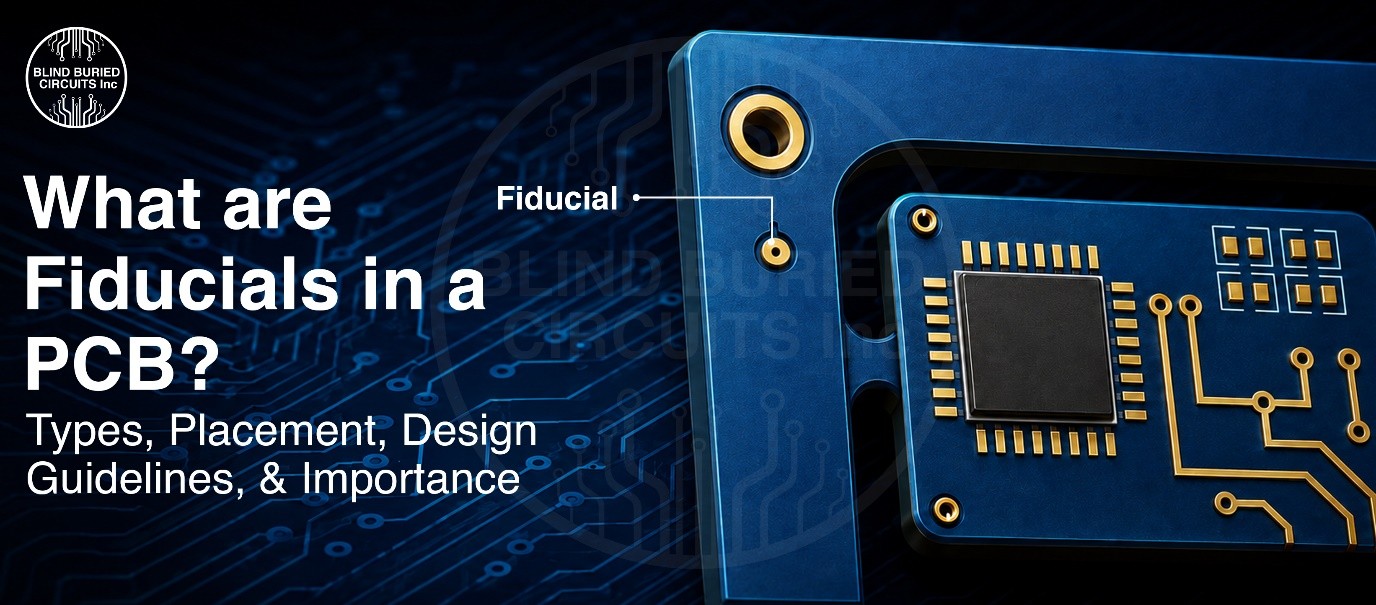
A fiducial PCB mark is a small exposed copper feature that serves as a reference point for automated PCB assembly equipment. It helps machine vision systems accurately align the PCB, ensuring precise solder paste printing, component placement, and inspection.
Why Are Fiducial Marks Important in PCB Assembly?
- Improve PCB alignment during SMT assembly
- Increase component placement accuracy
- Support precise solder paste printing
- Reduce assembly defects and rework
- Improve automated inspection accuracy
Why Are Fiducial Marks Important in PCB Assembly?
Modern PCB assembly depends on automated machines that place hundreds or even thousands of components with extreme precision. Before assembly starts, these machines use fiducial marks PCB to identify the board’s exact position and compensate for any slight rotation or movement.
This improves placement accuracy, minimizes manufacturing defects, and ensures consistent results across both prototype and production builds.
Benefits of Fiducials PCB
- Accurate PCB alignment
- Reliable SMT component placement
- Better solder paste printing accuracy
- Fewer placement defects and rework
- Consistent production quality
- Faster automated PCB assembly
Whether you’re producing a prototype or a high-volume production run, properly placed fiducials PCB help improve manufacturing efficiency and overall product reliability.
Types of Fiducials in PCB
Not all fiducial marks PCB serve the same purpose. Depending on the PCB design and assembly process, manufacturers use three main types of fiducials to improve alignment and placement accuracy.
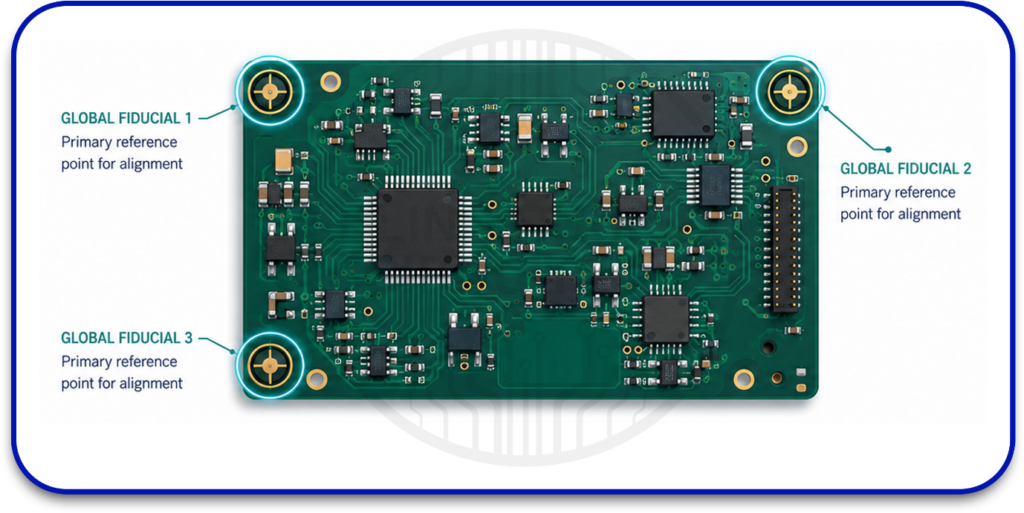
- Global Fiducials
Global fiducials are the primary reference points used by SMT machines to identify the PCB’s position and orientation before assembly begins.
They are usually placed near the corners of the board and help compensate for slight rotation or movement during manufacturing.
Best for:
- Standard SMT assembly
- Prototype PCBs
- Production PCB assembly
- Single-board alignment
- Local Fiducials
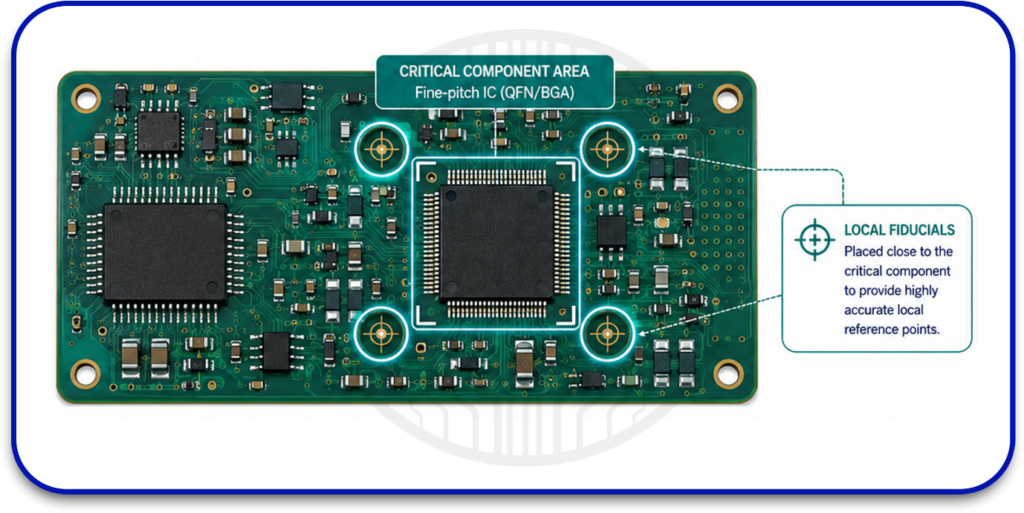
Local fiducials are placed near critical components that require higher placement accuracy. They provide an additional reference point for machine vision systems during component placement.
They are commonly used for:
- BGA packages
- QFN components
- CSP packages
- Fine-pitch ICs
- High-density PCB designs
Using local fiducials helps improve placement accuracy where even a small alignment error can affect solder joint quality.
- Panel Fiducials
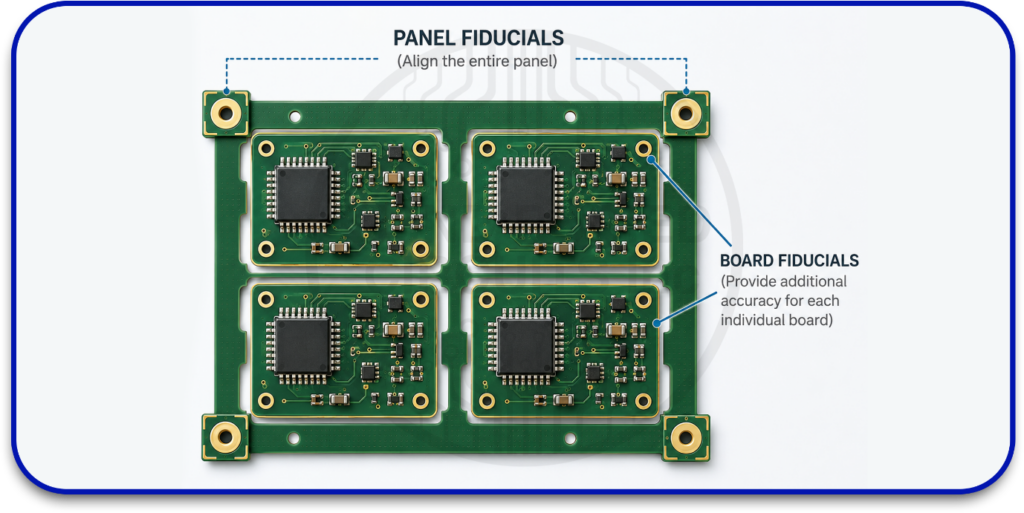
Panel fiducials are used when multiple PCBs are manufactured together in a single panel. They help automated equipment accurately align the entire panel before solder paste printing and component placement.
Once the panel is aligned, individual board fiducials provide additional positioning accuracy during assembly.
How Does a Fiducial PCB Work During Assembly?
During PCB assembly, automated machines use fiducial marks PCB as reference points to accurately position the board before solder paste printing and component placement. This helps ensure every SMT component is placed in the correct location.
PCB Assembly Process Using Fiducial Marks
- Board Detection: The machine’s vision system detects the global fiducial marks on the PCB.
- PCB Alignment: The machine aligns the board by compensating for any slight rotation or positional shift.
- Solder Paste Printing: The stencil is aligned with the fiducials to apply solder paste accurately to each pad.
- Component Placement: Pick-and-place machines use the fiducials to position SMT components with high precision.
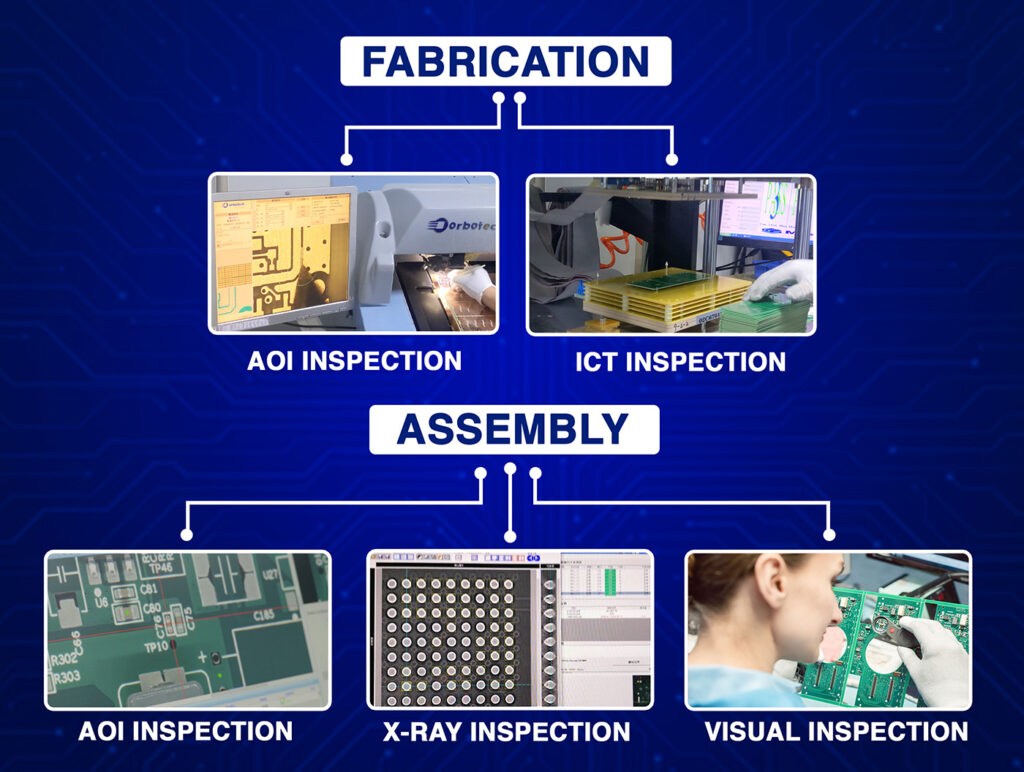
- Optical Inspection: AOI systems use the same reference marks to verify component placement and detect assembly defects.
PCB Alignment Reference Points (Benchmark Datums)
During automated PCB assembly, machines use multiple reference points to accurately identify the PCB’s position, orientation, and dimensional variations before component placement. These reference points, also known as benchmark datums, help improve alignment accuracy and reduce placement errors.
- Primary Datum: The primary datum establishes the PCB’s initial location using the board outline, tooling holes, or reference features. It provides the starting point for automated alignment.
- Secondary Datum (Global Fiducial): The secondary datum uses global fiducial marks to determine the PCB’s orientation and compensate for any slight rotation or positional shift. This ensures SMT components are placed in their correct locations.
- Tertiary Datum: The tertiary datum helps compensate for minor PCB expansion, shrinkage, or distortion that can occur during fabrication or thermal processing. This is particularly important for larger PCBs and panelized assemblies where small dimensional changes can affect placement accuracy.
What Is a Fiducial Marker?
A fiducial marker is a small exposed copper reference point on a PCB that helps automated assembly machines accurately align the board during manufacturing.
Where Are Fiducial Markers Placed?
Fiducial markers are strategically placed at different stages of the PCB manufacturing and assembly process to ensure accurate alignment and consistent component placement.
- On the PCB: Global fiducials are typically placed near the corners of the PCB to establish the board’s position and orientation. Local fiducials are added close to fine-pitch components such as BGAs, QFNs, and CSPs, where higher placement accuracy is required.
- On the PCB Panel: When multiple PCBs are manufactured as a panel, panel fiducials are placed along the panel edges or near tooling holes. These fiducials help automated equipment align the entire panel before assembly, while individual board fiducials provide additional alignment for each PCB.
- On the SMT Stencil: Stencil fiducials are used to accurately align the solder paste stencil with the PCB before printing begins. Proper stencil alignment ensures solder paste is deposited only on the intended pads, helping reduce printing defects and improve solder joint quality.
Common Fiducial Marker Designs Used in PCB Manufacturing
- Round (Dot) Fiducial: The most commonly used fiducial mark in PCB manufacturing. Its simple circular shape allows machine vision systems to detect and align the PCB quickly and accurately.
- Crosshair Fiducial: Uses intersecting lines as a reference point. It may be used in specialized applications where additional alignment accuracy is required.
- Copper Fiducial: A bare copper reference mark without solder mask covering it. This provides strong visual contrast for automated optical systems during PCB assembly.
- Grid Pattern Fiducial: Uses multiple reference points arranged in a pattern to improve alignment on larger or panelized PCBs.
- Corner Fiducial: Positioned near the PCB corners to help automated equipment determine the board’s orientation before solder paste printing and component placement.
Key Considerations for Fiducial PCB Design
| Design Consideration | Best Practice |
| Placement | Position global fiducials near the PCB corners and keep them away from the board edge for accurate alignment. |
| Shape & Size | Use circular fiducials with a consistent size across the PCB for reliable machine recognition. |
| Visibility | Keep fiducials free from solder mask, silkscreen, and nearby copper to improve camera detection. |
| Assembly Equipment | Design fiducials according to your PCB assembler’s machine and manufacturing requirements. |
| PCB Layout | Include fiducials during the PCB layout design stage to avoid alignment issues during assembly. |
Recommended Design Guidelines
- Use 2–3 global fiducial marks for accurate board alignment.
- Place global fiducials near the outer corners of the PCB.
- Add local fiducials near BGAs, QFNs, CSPs, and other fine-pitch components.
- Keep all fiducial marks the same size throughout the PCB whenever possible.
- Leave the fiducial free from solder mask and silkscreen for easy recognition.
- Maintain adequate clearance around each fiducial to improve camera detection.
- Add fiducials on both sides of the PCB for double-sided surface mount technology assembly.
Common Fiducial Placement Mistakes and Solutions
Even a well-designed PCB can experience assembly issues if fiducial marks are not placed correctly.
| Common Mistake | Impact | Recommended Solution |
| Too few global fiducials | Poor board alignment | Use at least two or three global fiducials. |
| Fiducials covered by solder mask | Vision system cannot detect the mark | Keep fiducials free from solder mask and silkscreen. |
| Fiducials placed too close to the board edge | Reduced detection accuracy | Maintain adequate clearance from the board edge. |
| Missing local fiducials near fine-pitch components | Component placement errors | Add local fiducials for BGAs, QFNs, and CSPs. |
| Different fiducial sizes | Inconsistent machine recognition | Use a consistent fiducial size across the PCB. |
Benefits of Using Fiducial Marks in PCB Assembly
- Improves Alignment Accuracy: Ensures precise PCB and component positioning during assembly.
- Reduces Assembly Errors: Minimizes component misalignment and soldering defects.
- Supports High-Density PCBs: Essential for accurately placing fine-pitch SMT components.
- Increases Production Efficiency: Helps automated machines assemble PCBs faster and more consistently.
- Enhances Product Quality: Improves manufacturing accuracy and overall PCB reliability.
Why Choose Blind Buried Circuits for PCB Layout and Assembly?
At Blind Buried Circuits, we provide precision PCB Layout Design Services and PCB Assembly Services to help you move from prototype to production with confidence.
Our engineering team follows industry best practices for fiducial placement, SMT manufacturability, and PCB design optimization to improve assembly accuracy and reduce production risks.
Why work with Blind Buried Circuits?
- Experienced PCB design and manufacturing engineers
- Design for Manufacturability (DFM) support
- Prototype to production PCB assembly
- Advanced SMT manufacturing capabilities
- Strict quality control and inspection
- Fast turnaround with reliable technical support
Whether you’re developing a new product or optimizing an existing design, our team is ready to support your next PCB project.
Frequently Asked Questions
- How many fiducial marks should a PCB have?
Ans: Most PCBs use two or three global fiducial marks for board alignment. Local fiducials may be added near fine-pitch components when higher placement accuracy is required.
- Are fiducial marks required on every PCB?
Ans: Not always. Simple or manually assembled PCBs may not require fiducials. However, they are strongly recommended for automated SMT assembly, especially on complex or high-density designs.
- Where should fiducial marks be placed?
Ans: Global fiducials are typically placed near the outer corners of the PCB, while local fiducials are positioned close to BGAs, QFNs, CSPs, and other fine-pitch components.
- What size should a fiducial mark be?
Ans: Most PCB manufacturers recommend a fiducial diameter between 1 mm and 3 mm, with consistent sizing and adequate clearance for reliable machine vision recognition.
- What happens if a PCB doesn’t have fiducial marks?
Ans: Without fiducial marks, automated assembly equipment may have difficulty aligning the board accurately. This can increase the risk of component placement errors, rework, and reduced manufacturing efficiency.